Real-Time Vulnerability Detection vs Scheduled Scanning: Which Protects Your Business Better?
There is a moment every security-conscious business leader eventually faces. The quarterly security report comes in, the scan results look acceptable, the team ticks the compliance box, and everyone moves on. Three weeks later, a vulnerability introduced in a recent product update gets exploited, and nobody saw it coming because the next scheduled scan was still six weeks away.
This is not a hypothetical. It is one of the most common patterns Capture The Bug encounters when working with growing businesses across Australia, New Zealand, and the United States.
The debate between real-time vulnerability detection and scheduled scanning is not purely technical. It is a business decision with direct consequences for how exposed a company is at any given moment, how fast it can respond when something goes wrong, and whether its security programme reflects the actual pace at which its product and infrastructure change.
This blog breaks down what each approach actually means in practice, where each one fits, and why the most serious businesses are moving toward continuous, evidence-based security testing as the standard, not the exception.
What Scheduled Scanning Actually Is
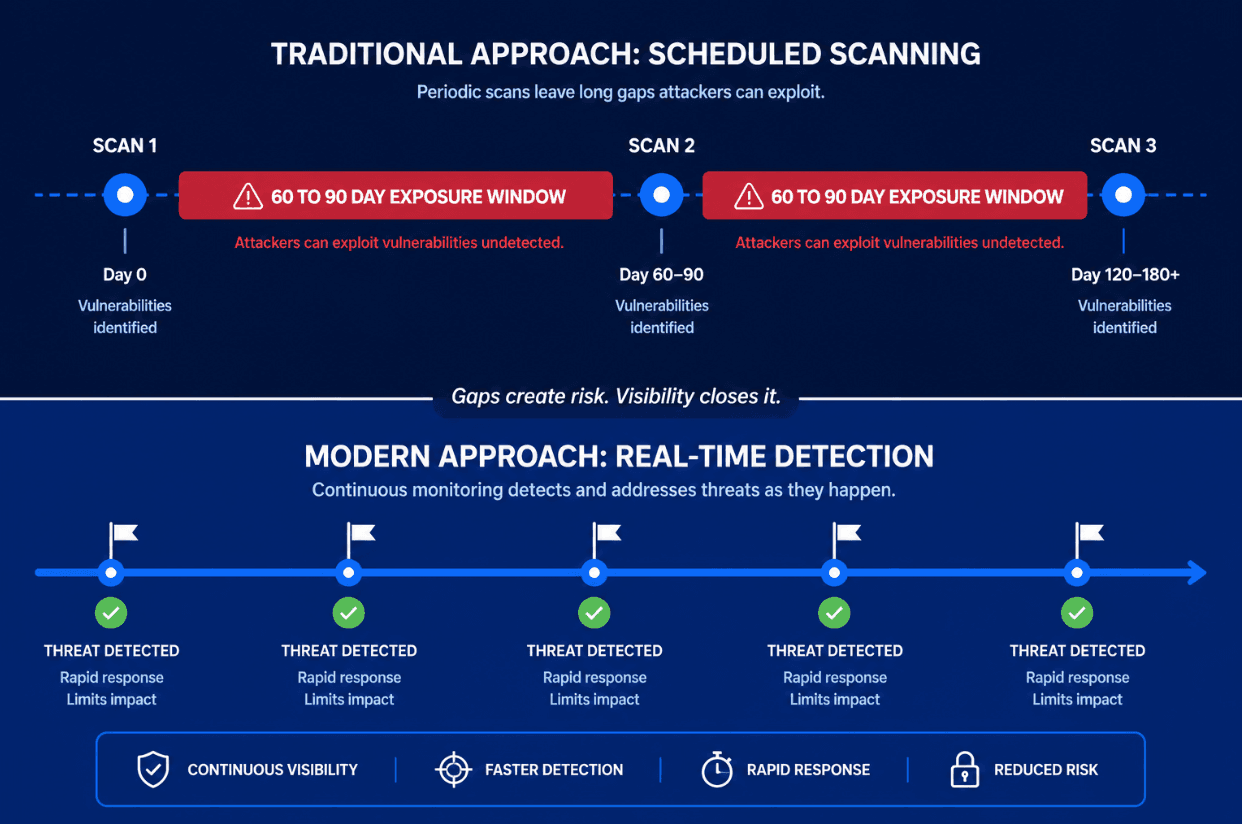
Scheduled scanning refers to security assessments that run at fixed intervals. This could be a monthly vulnerability report, a quarterly penetration test, or an annual third-party security review. The assessment happens on a predetermined date, covers the environment as it exists at that moment, and produces a report that reflects a point-in-time snapshot.
For a long time, scheduled scanning was considered the responsible approach to security. It was structured, predictable, and it produced documented evidence that a company had performed due diligence. Regulators accepted it. Insurance providers accepted it. Enterprise clients accepted it.
The problem is that scheduled scanning was designed for a world where business systems changed slowly. A company might deploy new software twice a year and add one or two new integrations per quarter. In that environment, a snapshot taken every three months was reasonably current most of the time.
That world no longer exists for most businesses, and it especially does not exist for technology companies, SaaS platforms, fintech firms, or any organisation that ships product updates regularly. When a business deploys a new feature, onboards a third-party tool, migrates a workload to a new cloud environment, or changes the way its APIs authenticate requests, the attack surface changes. If the next scheduled scan is weeks away, that change sits unreviewed for weeks. That window is precisely where opportunistic attackers focus.
What Real-Time Vulnerability Detection Actually Means
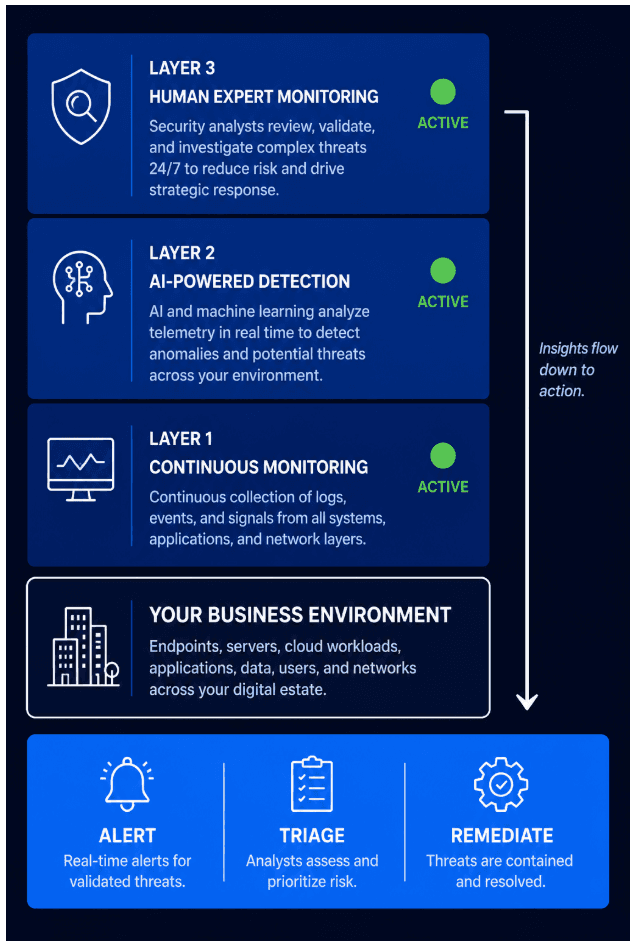
Real-time vulnerability detection is the practice of continuously monitoring systems, configurations, and code for security weaknesses as they emerge, rather than waiting for a scheduled assessment to surface them.
This is fundamentally different from a periodic scan. Instead of taking a snapshot at a fixed point in time, real-time detection maintains an ongoing view of the security posture across the environment. When a new misconfiguration appears, when a known vulnerability is identified in a library the business relies on, or when unusual behaviour suggests that a control has broken down, the detection happens immediately rather than at the next review cycle.
It is important to understand what real-time detection is not. It is not a replacement for deep, expert-led penetration testing. Continuous monitoring catches known weaknesses and configuration drift. What it does not do is replicate the judgement, creativity, and attack chain construction that an experienced penetration tester brings to a targeted engagement. Real-time detection and penetration testing are complementary. The monitoring tells a business what has changed and what new weaknesses have appeared. The penetration test tells the business how far an attacker could actually go if they exploited those weaknesses in combination.
Where Each Approach Falls Short
Scheduled scanning has a structural weakness that no amount of rigour can fully overcome: it is always describing the past. The report a business receives at the end of a quarterly assessment reflects how the environment looked on the day the assessment ran. By the time the report is reviewed, findings are prioritised, and remediation is underway, the environment has already changed again.
For businesses that operate at speed, this lag is not acceptable. A vulnerability left open for sixty days is not a theoretical risk. It is an operational exposure with real consequences.
Real-time detection has its own limitations. The alerts it produces are only as valuable as the team capable of triaging and responding to them. Without skilled security professionals interpreting findings in the context of the specific business environment, real-time alerts can generate significant noise without producing meaningful security improvement. Volume is not the same as insight. There is also the issue of depth. Real-time monitoring tools are excellent at identifying known vulnerability patterns and configuration issues. They are not designed to discover how an attacker would chain multiple low-severity findings into a high-impact breach. That capability requires human expertise, and it requires a structured penetration testing engagement of the kind Capture The Bug delivers through capturethebug.xyz/Services/penetration-testing.
The Business Case for Continuous Security Testing
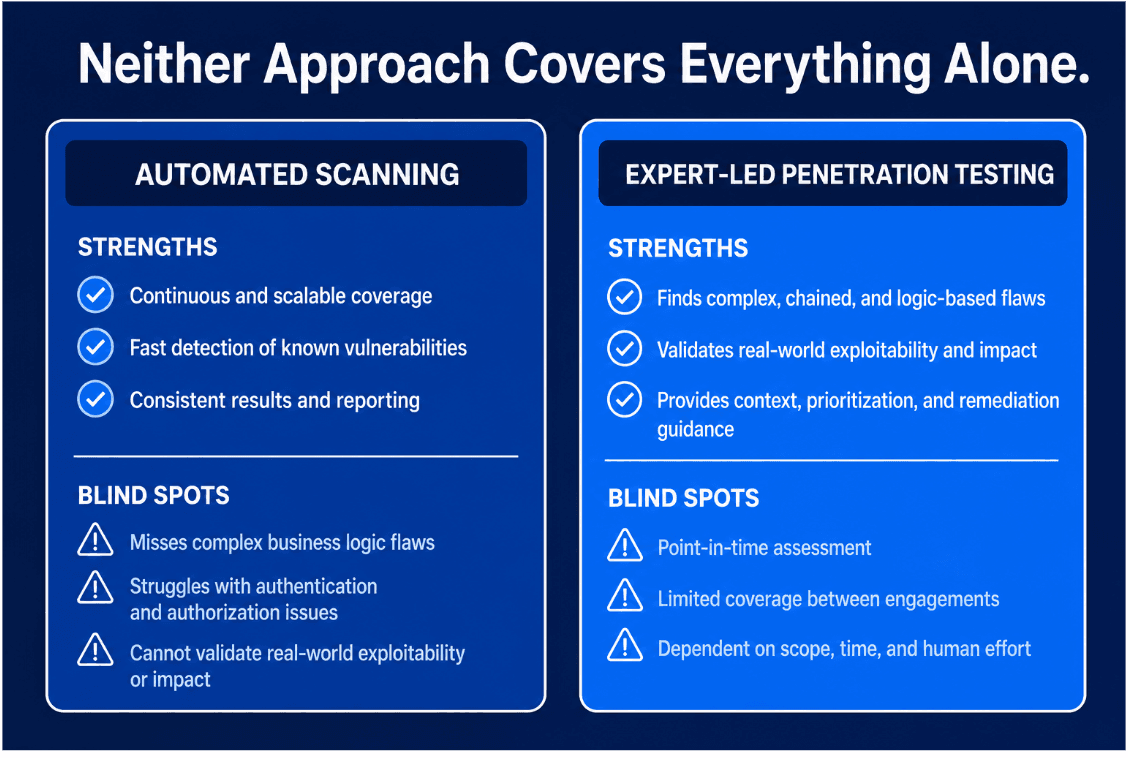
The conversation in forward-thinking security teams has moved beyond the binary of scheduled versus real-time. The question is no longer which one a business should choose. The question is how to build a programme that combines both in a way that reflects the actual risk profile and pace of the business.
Capture The Bug works with clients to design security testing programmes that treat these two approaches as complementary rather than competing.
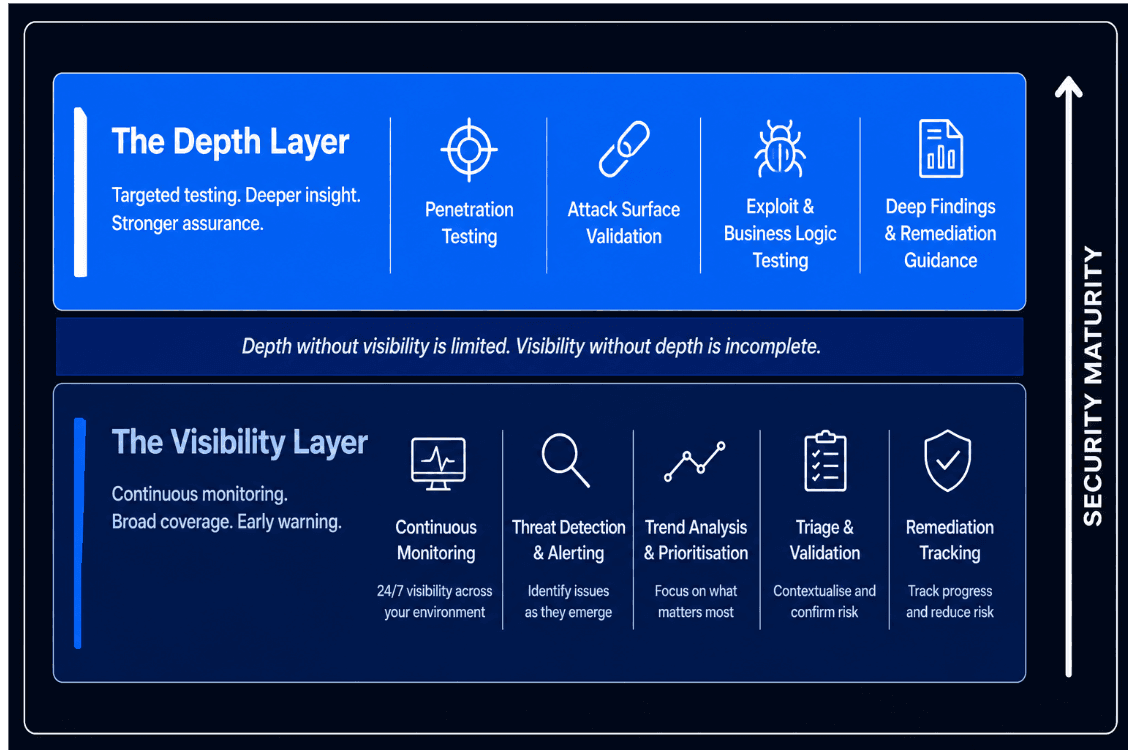
Continuous monitoring provides the visibility layer. It keeps a live view of the environment, flags configuration drift, surfaces known vulnerabilities as they are disclosed, and ensures that the security team is never entirely flying blind between formal testing engagements.
Penetration testing provides the depth layer. It tests how the environment holds up against a motivated, skilled adversary who is not limited to known vulnerability patterns. It discovers the attack paths that monitoring tools do not see because those paths require human reasoning, not pattern matching. For businesses that are growing quickly, adding integrations, building new product features, or expanding into regulated markets, neither layer is optional. The combination is what produces a security programme that is both current and deep.
How to Decide What Your Business Needs Right Now
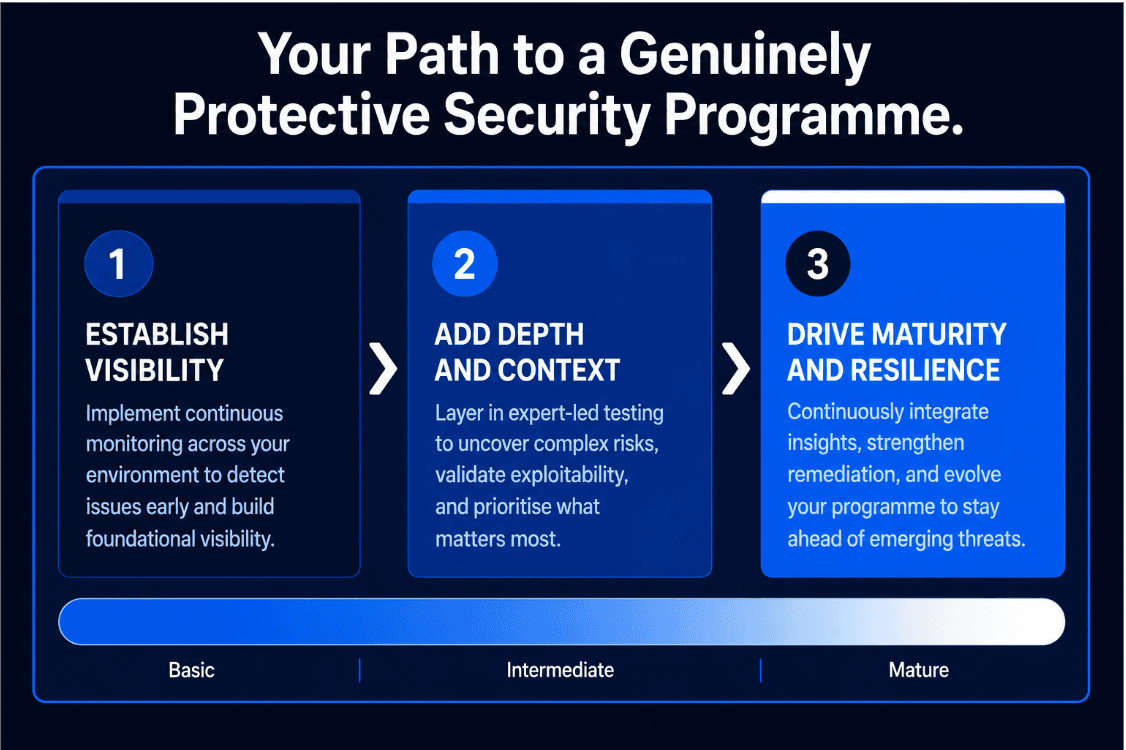
Not every business is at the same stage of security maturity, and the right starting point depends on where an organisation currently sits.
For businesses that have never conducted a formal penetration test, the most urgent priority is understanding the actual state of their security posture. Continuous monitoring tells a business about known weaknesses. It does not tell a business what an attacker could do with access to its specific environment. That requires a structured engagement.
Capture The Bug recommends that any business handling customer data, processing payments, managing sensitive personal information, or operating in a regulated industry begin with a thorough penetration test before layering in continuous monitoring. The penetration test establishes the baseline and identifies the areas where monitoring should be most focused.
For businesses that already conduct periodic testing but recognise the gap problem described earlier, the next step is building a programme with a defined cadence. This means scheduling penetration testing at intervals that reflect the pace of change in the business, supplemented by continuous monitoring in between. When the environment changes significantly, testing follows the change, not the calendar. For businesses operating at scale with established security teams, the integration of real-time detection, regular expert-led testing, and structured incident response represents the full maturity model.
Why the Attacker Perspective Changes Everything
One of the most important things Capture The Bug brings to this conversation is the attacker's perspective.
When a business looks at its own security, it tends to see what it has built and what it intended. When a penetration tester looks at the same environment, they see the gaps between what was intended and what was actually delivered. They see the authentication flow that works correctly in the happy path but breaks under specific conditions. They see the API endpoint that was meant to be internal but is reachable from the public internet. They see the combination of a low-severity misconfiguration and a medium-severity vulnerability that together produce a critical breach path.
Scheduled scanning does not see these things because it is not designed to. Real-time monitoring does not see these things because it matches against known patterns rather than reasoning about attack chains.
Penetration testing sees these things because skilled testers approach the environment the way an attacker would, and the findings that result are the ones that actually matter for protecting a business. This is why Capture The Bug structures every engagement around real-world objectives rather than checkbox compliance. A finding that a vulnerability exists is less valuable than a finding that shows exactly how that vulnerability could be used to access customer financial records, bypass payment controls, or move laterally through an internal network.
Conclusion: The Right Question is Not Either Or
The real-time versus scheduled debate is not the right frame for most businesses. Both approaches serve a purpose, and neither is sufficient on its own.
The right question is whether a business has a security programme that matches the actual pace and complexity of how its environment changes, and whether the testing it conducts is deep enough to catch what monitoring alone will miss.
Capture The Bug works with businesses across Australia, New Zealand, and the United States to answer both of those questions through rigorous, expert-led penetration testing combined with the strategic guidance needed to build a programme that stays current. Close the gap between scans and protect your digital growth. Learn more at capturethebug.xyz/Services/penetration-testing.
Plan Your Annual Pentesting Strategy the Right Way
Learn how modern SaaS companies structure pentesting across the year to reduce risk, stay compliant, and avoid last-minute panic before audits.

Frequently Asked Questions
What is the difference between real-time vulnerability detection and scheduled scanning?
Scheduled scanning takes a point-in-time snapshot of a business environment at fixed intervals, such as monthly or quarterly. Real-time vulnerability detection continuously monitors the environment for new weaknesses as they emerge. The key difference is the time between when a vulnerability appears and when it is identified. Scheduled scanning can leave that window open for weeks or months, while real-time detection shortens it significantly.
Can real-time vulnerability detection replace penetration testing?
No. Real-time vulnerability detection identifies known weaknesses and configuration issues as they appear. Penetration testing goes further by simulating how a skilled attacker would chain multiple vulnerabilities together to achieve a specific objective, such as accessing customer data or bypassing payment controls. Both serve different purposes, and serious security programmes use both in combination.
How often should a business conduct penetration testing?
The right frequency depends on how quickly the business environment changes. As a baseline, annual penetration testing is the minimum for most organisations. Businesses that release product updates regularly, add new integrations, or operate in regulated industries should test more frequently, typically quarterly or whenever significant changes are made to the environment. Capture The Bug helps clients determine the right cadence for their specific risk profile.
What is the security gap between scans, and why does it matter?
The security gap refers to the period between one security assessment and the next, during which changes to the environment go unreviewed and undetected vulnerabilities remain open. During this window, newly introduced weaknesses from product updates, third-party integrations, or configuration changes are visible to attackers but invisible to the business. Closing this gap is one of the primary reasons businesses move toward more frequent testing and continuous monitoring.
Which businesses are most at risk from infrequent security scanning?
Technology companies, SaaS platforms, fintech businesses, and any organisation that ships product updates regularly face the highest risk from infrequent scanning because their attack surface changes the most between assessments. Businesses operating in regulated industries such as financial services, healthcare, and data-heavy sectors also carry elevated risk because regulatory obligations require demonstrable and current evidence of security testing.
What does Capture The Bug recommend for businesses starting their security programme?
Capture The Bug recommends beginning with a thorough penetration test to establish a clear understanding of the actual security posture before layering in continuous monitoring. The penetration test identifies where the most significant risks sit, which informs where monitoring should be most focused and what the priorities for remediation should be. Without that baseline, continuous monitoring produces alerts without the context needed to act on them effectively.
How does real-time detection support penetration testing programmes?
Real-time detection provides the visibility layer between penetration testing engagements. It flags new known vulnerabilities as they are disclosed, identifies configuration drift as the environment changes, and ensures the security team has current information between formal testing cycles. When a new penetration test runs, the findings from continuous monitoring inform the scope and focus of the engagement, making both activities more effective together than either would be alone.