How Continuous Penetration Testing Helps You Pass SOC 2, ISO 27001, and PCI-DSS Audits
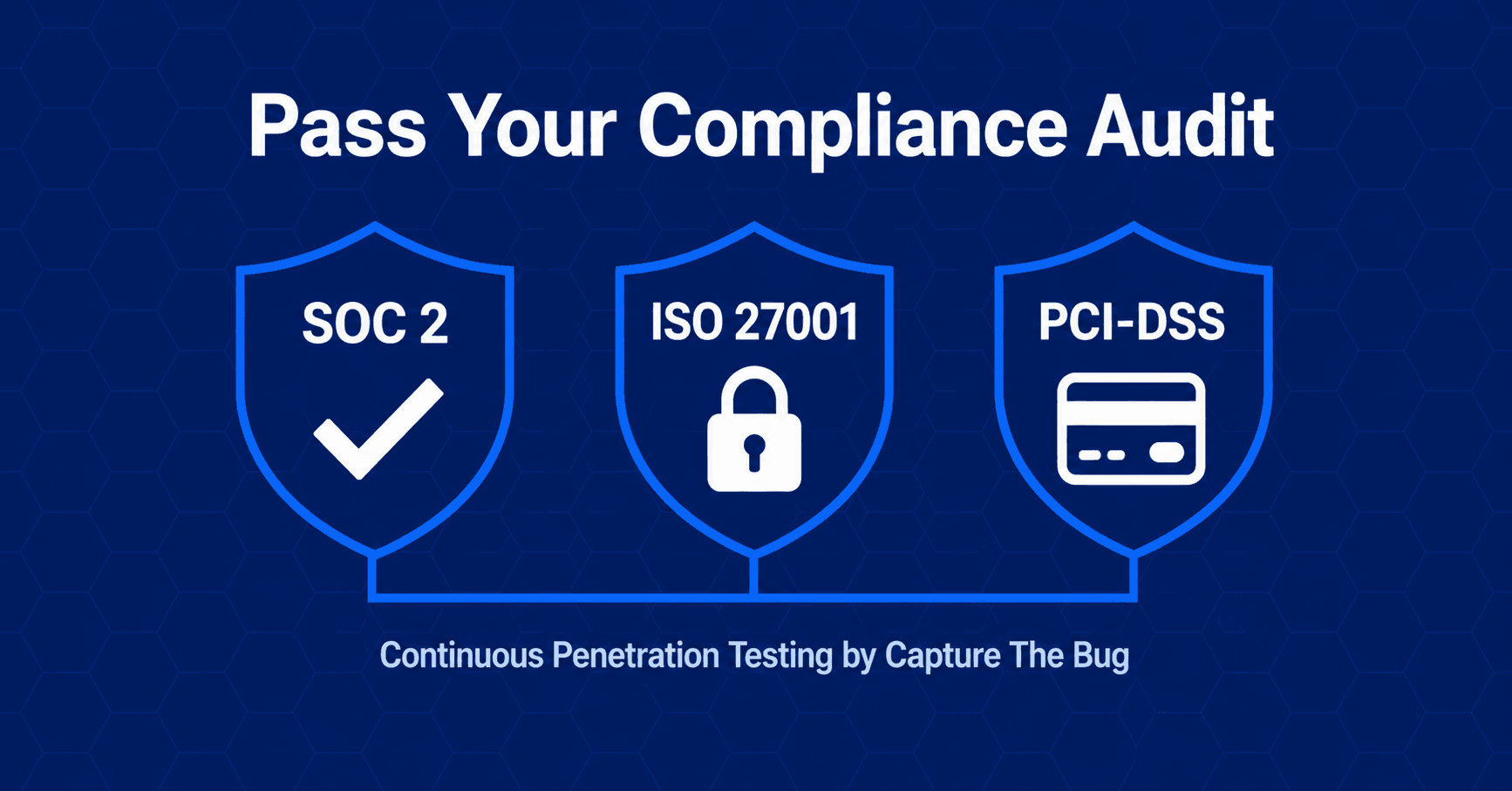
There is a specific moment most CTOs and CISOs recognise when they hear it described. It usually happens two or three weeks before an audit. Someone pulls up the penetration testing report from earlier in the year, and it is immediately obvious that the findings from that engagement do not reflect the environment being audited today. The codebase has changed. New services are live. The report is, for practical purposes, a historical document.
The auditor does not care about what your security posture looked like six months ago. They care about what it looks like now.
This is the core problem with treating penetration testing as a once-a-year exercise. The frameworks most companies are trying to satisfy—SOC 2, ISO 27001, and PCI-DSS—were written with this exact gap in mind. And yet, year after year, businesses arrive at audits with stale evidence, remediation gaps, and incomplete documentation.
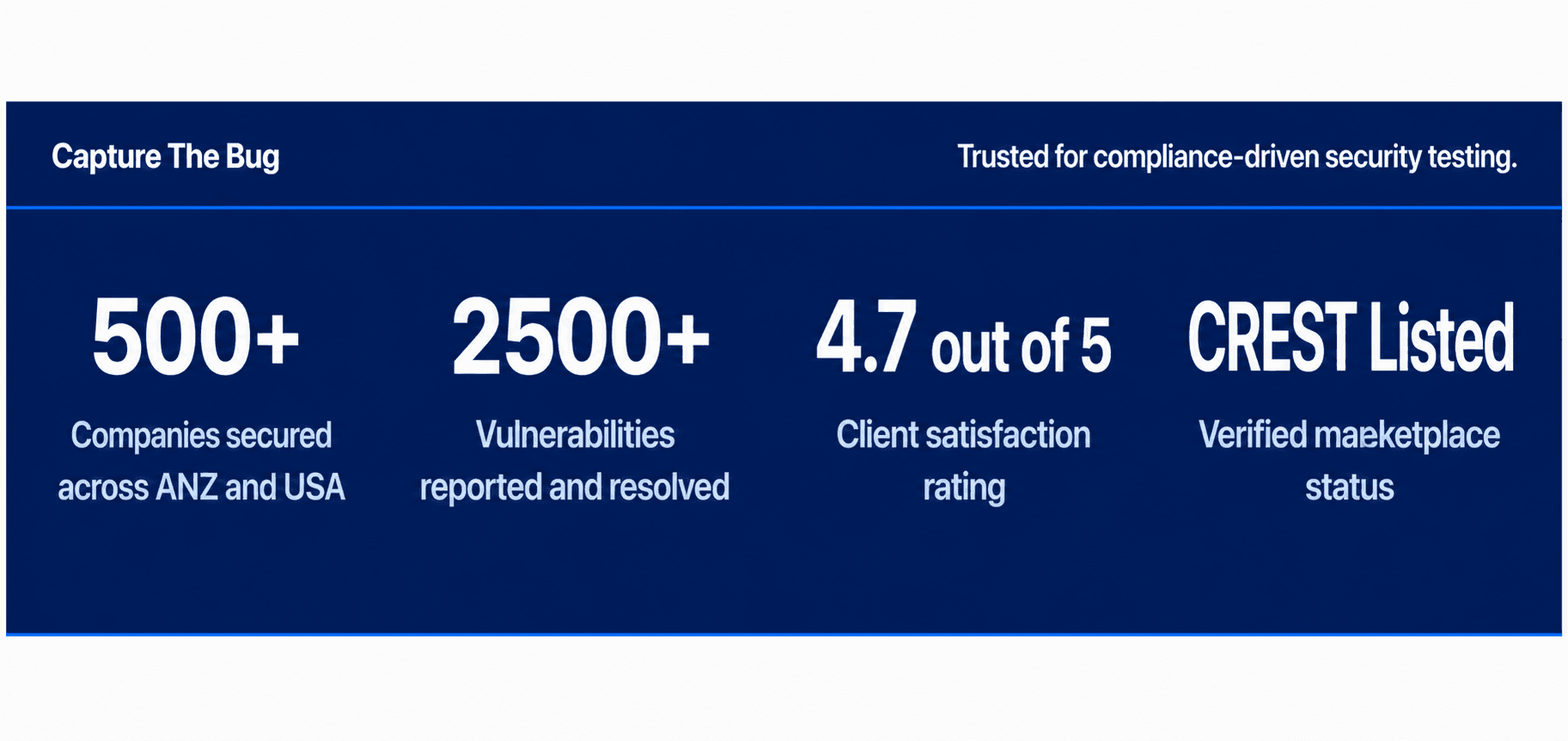
Capture The Bug has worked with hundreds of companies across Australia, New Zealand, and the United States navigating exactly this situation. What follows is a straightforward explanation of what each framework actually requires, why continuous testing changes the outcome, and what that process looks like in practice.
What the Frameworks Are Actually Looking For
Each of the three major compliance frameworks approaches security testing differently, but all three share the same underlying logic: evidence that security is an ongoing practice, not a one-time event.
SOC 2 does not specify a fixed number of penetration tests per year. What it does require, under the Common Criteria and the Availability, Confidentiality, and Processing Integrity categories, is that a company can demonstrate continuous monitoring and timely remediation of identified vulnerabilities. A single annual report does not demonstrate a continuous process. It demonstrates a point in time.
ISO 27001 is built around the concept of a continually improving Information Security Management System (ISMS). Annex A, specifically controls A.12.6.1 and A.18.2.3, requires that technical vulnerabilities are identified and addressed on an ongoing basis, and that information systems are regularly reviewed for compliance. An audit team evaluating ISO 27001 compliance is looking for process evidence: testing logs, remediation records, and proof that findings were tracked and resolved within a defined timeframe.
PCI-DSS is the most prescriptive of the three. Requirement 11 mandates internal and external penetration testing at least once per year and after any significant infrastructure or application upgrade. But "at least once per year" is the floor, not the ceiling. Payment card data environments change constantly, and auditors increasingly expect to see testing that reflects those changes in something closer to real time.
What all three frameworks are asking for, in different ways, is a security testing programme that can generate current evidence on demand. That is precisely what continuous penetration testing is designed to produce.
Why Annual Testing Creates a Compliance Gap
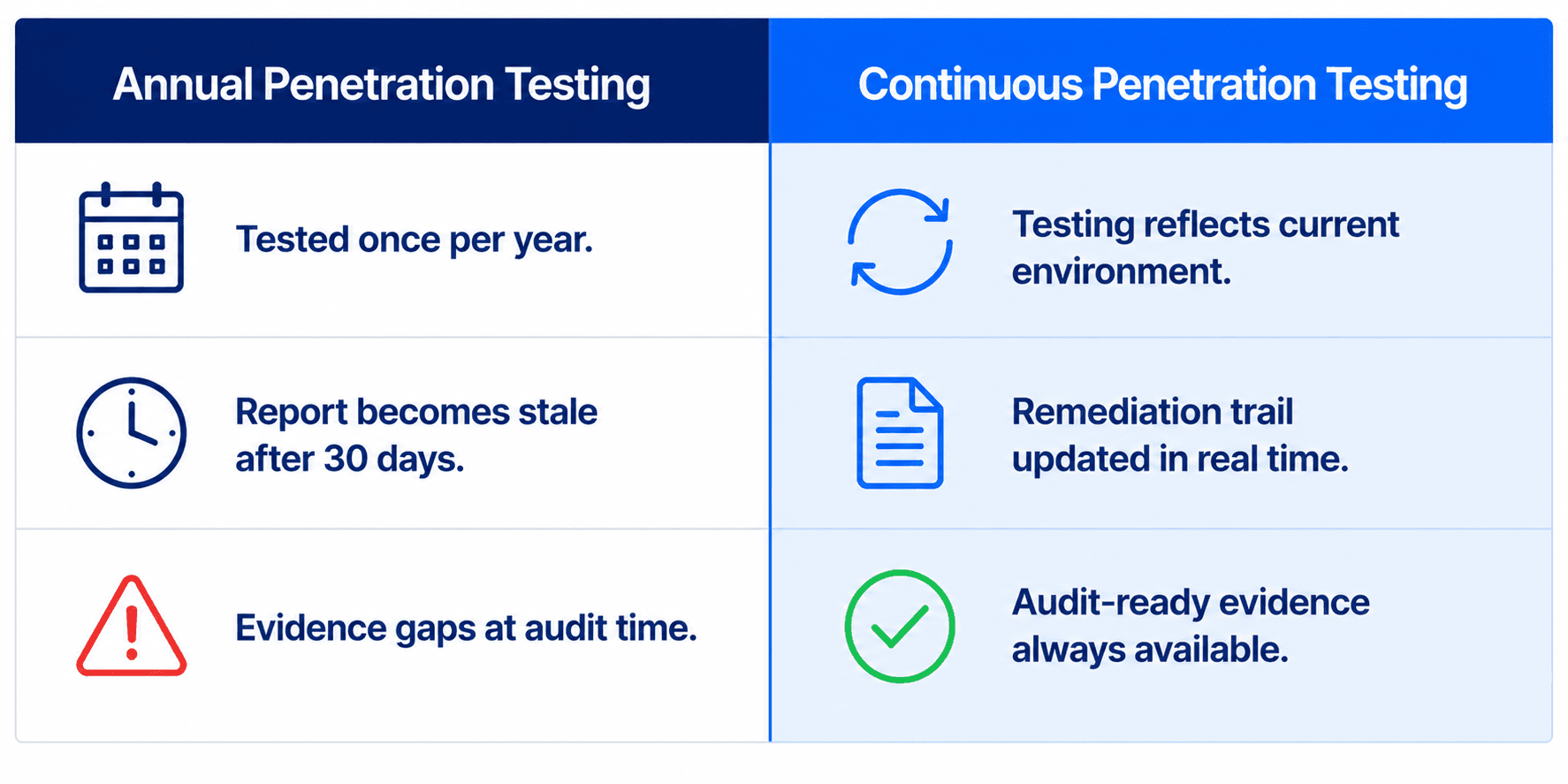
A traditional penetration test is scoped, executed, documented, and delivered. The findings are real and the report is valuable. But the moment the test ends, the clock starts running on how accurate that report remains.
Most SaaS companies and growth-stage businesses ship code regularly. New endpoints are introduced. Integrations are added. Infrastructure is modified. Every one of those changes is a potential change to the attack surface. By the time an annual pentest report is six months old, it may no longer be a reliable representation of what an attacker would actually find.
This creates two specific problems at audit time.
The first is an evidence problem. If an auditor asks for documentation showing that a vulnerability identified in March was remediated and retested, and the next scheduled test is not until November, there is no documentation to provide. The finding sits open in a report with no paper trail of resolution.
The second is a scope problem. If new functionality was shipped after the last test, that functionality was never assessed. It exists outside the compliance perimeter, not because anyone made a deliberate choice to exclude it, but simply because the testing schedule did not accommodate it.
Both problems are solvable. The solution is not more frequent traditional pentests. It is a testing model that is continuous, documented, and integrated into how the business already operates. Capture The Bug's penetration testing services are built around exactly that model. The approach covers web applications, APIs, network infrastructure, and cloud environments on an ongoing basis, generating findings and remediation evidence that are current at any point in the compliance cycle.
How Continuous Testing Supports Each Framework
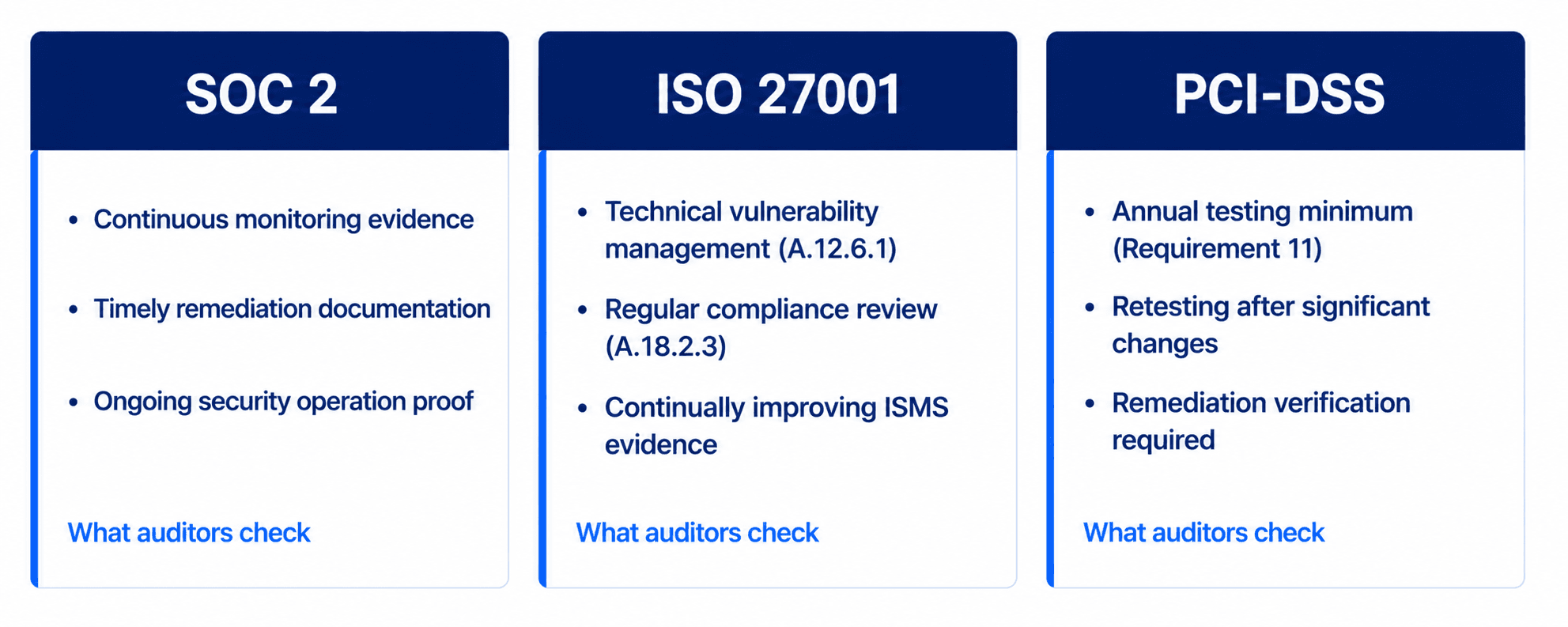
For SOC 2, the value of continuous testing is in the evidence trail it produces. Every finding, every retested remediation, and every clean test cycle becomes part of a documented record. When a SOC 2 auditor asks for evidence of continuous monitoring and timely remediation, that record is the answer. It shows not just that testing happened, but that the process functions as a system.
For ISO 27001, the benefit is alignment with the standard's own language. ISO 27001 is a management system standard. It is designed around processes that are planned, executed, monitored, and improved. A continuous testing programme fits that structure naturally. It produces the measurement data the standard expects and supports the internal audit and management review requirements that sit alongside the technical controls.
For PCI-DSS, continuous testing directly addresses the retesting obligation. Requirement 11.3 requires that vulnerabilities identified during penetration testing are corrected and that the test is repeated to verify the correction. Under a continuous model, retesting is built into the process rather than scheduled separately. Remediation can be verified quickly and documented accurately, which is exactly what a Qualified Security Assessor (QSA) is looking for.
Across all three frameworks, there is one consistent theme: auditors want to see that security is treated as an operational function, not a compliance calendar event. Continuous testing is the most direct way to demonstrate that.
What Remediation Evidence Actually Looks Like
One of the most common gaps Capture The Bug sees in compliance-focused security programmes is not a lack of testing. It is a lack of usable remediation documentation.
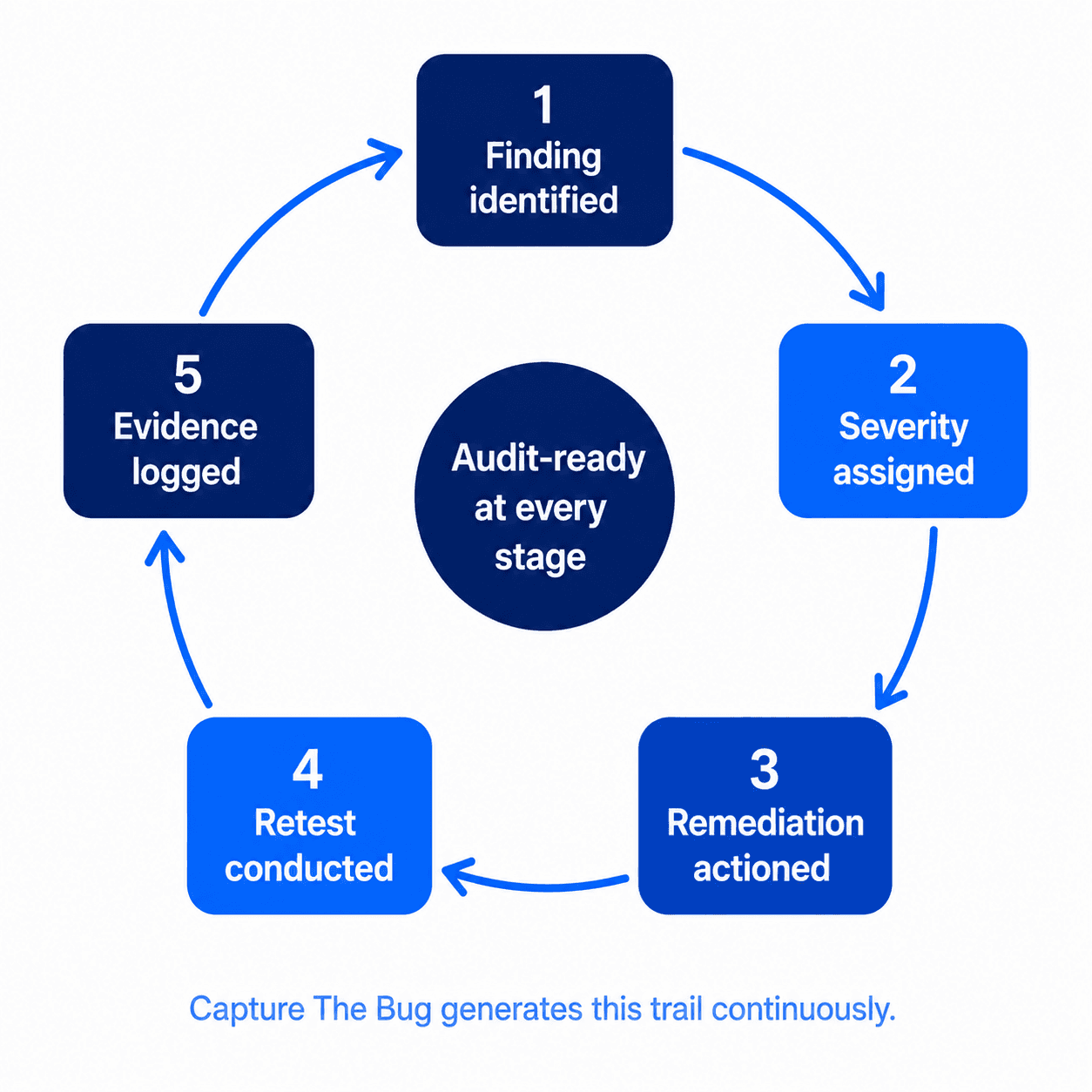
A finding that says "SQL injection vulnerability in the user authentication endpoint" is a starting point. What an auditor needs to see is the full lifecycle: when the finding was identified, what severity it was assigned, what remediation action was taken, when retesting occurred, and what the retest result was. Without that trail, the finding exists in a report but provides no compliance value.
Continuous testing generates that trail as part of the normal process. Findings are logged with timestamps. Remediation is tracked. Retests produce new findings or confirm resolution. The output is not just a report. It is a compliance-ready evidence record.
For companies preparing for SOC 2 Type II, this distinction is critical. Type II assesses whether controls operated effectively over a period of time, typically six to twelve months. A single penetration test conducted at the start of that period proves very little. A continuous testing programme with documented activity throughout the period proves a great deal.
Scoping for Compliance Across Changing Environments
One practical concern companies raise when considering continuous testing is scope management. If the environment is always changing, how does testing keep up?
The answer is in how scope is defined. Rather than locking down a fixed set of assets at the start of an engagement, a continuous testing approach works from a living scope that reflects the actual environment. When new assets are added, they enter the testing cycle. When assets are decommissioned, they drop out. The scope reflects reality rather than a snapshot taken at engagement kickoff.
For PCI-DSS specifically, this is significant. The cardholder data environment is not static. New payment flows, third-party integrations, and infrastructure changes all have the potential to bring new assets into scope. A continuous testing programme that maintains a living scope is far better positioned to demonstrate compliance across that changing perimeter than one that assessed a fixed scope on a specific date.
Capture The Bug structures its engagements around this kind of scope flexibility. The testing methodology is designed to accommodate the pace at which modern SaaS products and enterprise platforms actually change. More detail on how those engagements are structured is available at our penetration testing page.
The Auditor Conversation You Want to Be Having
The best compliance audit conversation a security team can have is a short one. The auditor asks for evidence of penetration testing, remediation, and ongoing monitoring. The security team hands over a complete, current, well-organised record. The auditor reviews it, confirms it meets the requirements, and moves on.
That conversation is only possible when the underlying programme produces the right kind of documentation. A penetration testing report from last year, with some remediation notes in an email thread, does not produce that conversation. A continuous testing programme with a structured evidence record does.
This is not an abstract distinction. It is the difference between a clean audit outcome and a finding that requires remediation before certification can proceed. For companies with SOC 2, ISO 27001, or PCI-DSS timelines tied to enterprise sales cycles, investor requirements, or regulatory obligations, that difference has direct commercial consequences.
Continuous penetration testing is not a premium option for companies with large security budgets. It is the most practical approach to compliance for any organisation that ships software regularly and needs to demonstrate security on an ongoing basis. Capture The Bug is built to deliver that, for companies at every stage, across ANZ and the US.
Get Audit-Ready Without the Guesswork
Download a complete SOC 2 checklist designed for fast-growing SaaS companies. Know exactly what auditors expect and fix gaps before they cost you deals.
Download Your SOC 2 Checklist Now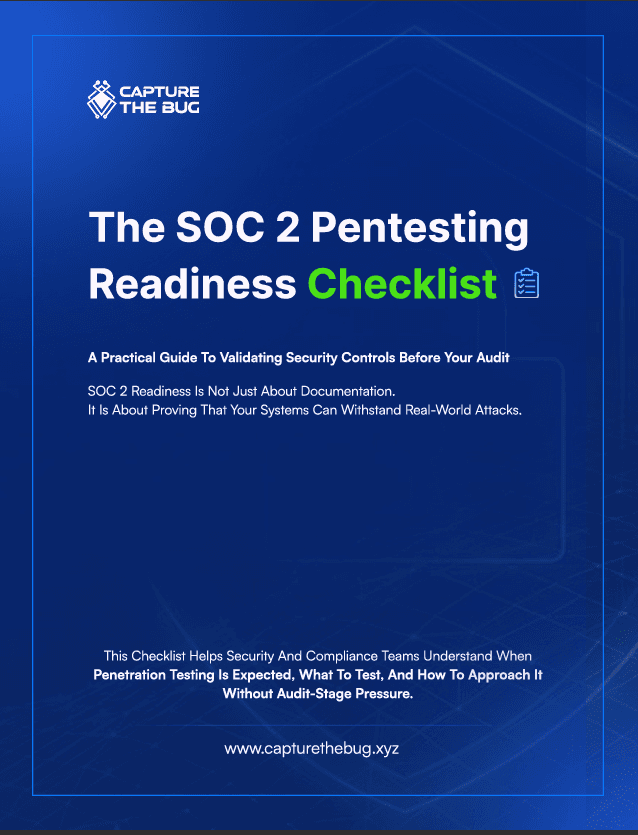
Frequently Asked Questions
Does SOC 2 require penetration testing?
SOC 2 does not mandate penetration testing by name, but the Trust Services Criteria require evidence of continuous monitoring and timely remediation of vulnerabilities. In practice, penetration testing is the most widely accepted method for generating that evidence, and most SOC 2 auditors expect to see it as part of a mature security programme.
How often should penetration testing happen for ISO 27001 compliance?
ISO 27001 requires ongoing identification and management of technical vulnerabilities rather than a fixed annual schedule. Most certification bodies expect to see testing conducted at a frequency that reflects the rate of change in the environment. For organisations that release software regularly, continuous or quarterly testing is typically more appropriate than annual testing.
What does PCI-DSS Requirement 11 say about penetration testing?
PCI-DSS Requirement 11.3 mandates penetration testing of the cardholder data environment at least annually and after any significant changes. It also requires that identified vulnerabilities are corrected and retested. A continuous testing programme addresses both the testing frequency requirement and the retesting obligation as part of a single ongoing process.
What is the difference between a vulnerability assessment and a penetration test for compliance purposes?
A vulnerability assessment identifies potential weaknesses using automated checks and is useful for broad coverage. A penetration test involves a tester actively attempting to exploit identified weaknesses to determine their real-world impact. SOC 2, ISO 27001, and PCI-DSS all treat penetration testing as a distinct and more rigorous activity than a vulnerability assessment. For compliance purposes, both are valuable but serve different evidential functions.
Can continuous penetration testing replace an annual pentest for PCI-DSS?
Continuous penetration testing can satisfy and exceed the annual testing requirement if the programme covers the full cardholder data environment scope, generates findings with severity ratings, and documents remediation and retesting outcomes. The key requirement is that the testing is conducted by qualified personnel and that the outputs meet the documentation standards QSAs expect to review.