PTaaS for SaaS Startups: When Is the Right Time to Start and What Does It Cost?
There is a conversation that happens regularly in early-stage SaaS companies. It usually starts with someone asking whether the product is "secure enough" and ends with a decision to revisit the question after the next funding round, the next major release, or the next enterprise sales conversation. Security testing gets filed under future priorities.
Then one of three things happens. A prospect's security questionnaire comes back with questions the team cannot answer. An enterprise procurement process stalls because there is no penetration testing report to provide. Or something breaks in a way that costs time, money, and customer trust that took months to build.
The question of when to start security testing is not really a technical question. It is a business timing question. And the cost of getting the timing wrong is almost always higher than the cost of starting sooner.
Capture The Bug works with SaaS companies at every stage, from pre-revenue startups to growth-stage platforms preparing for enterprise contracts. What follows is a straightforward breakdown of when to start, what to expect at each stage, and what the real costs look like.
The Three Moments When SaaS Companies Typically Start
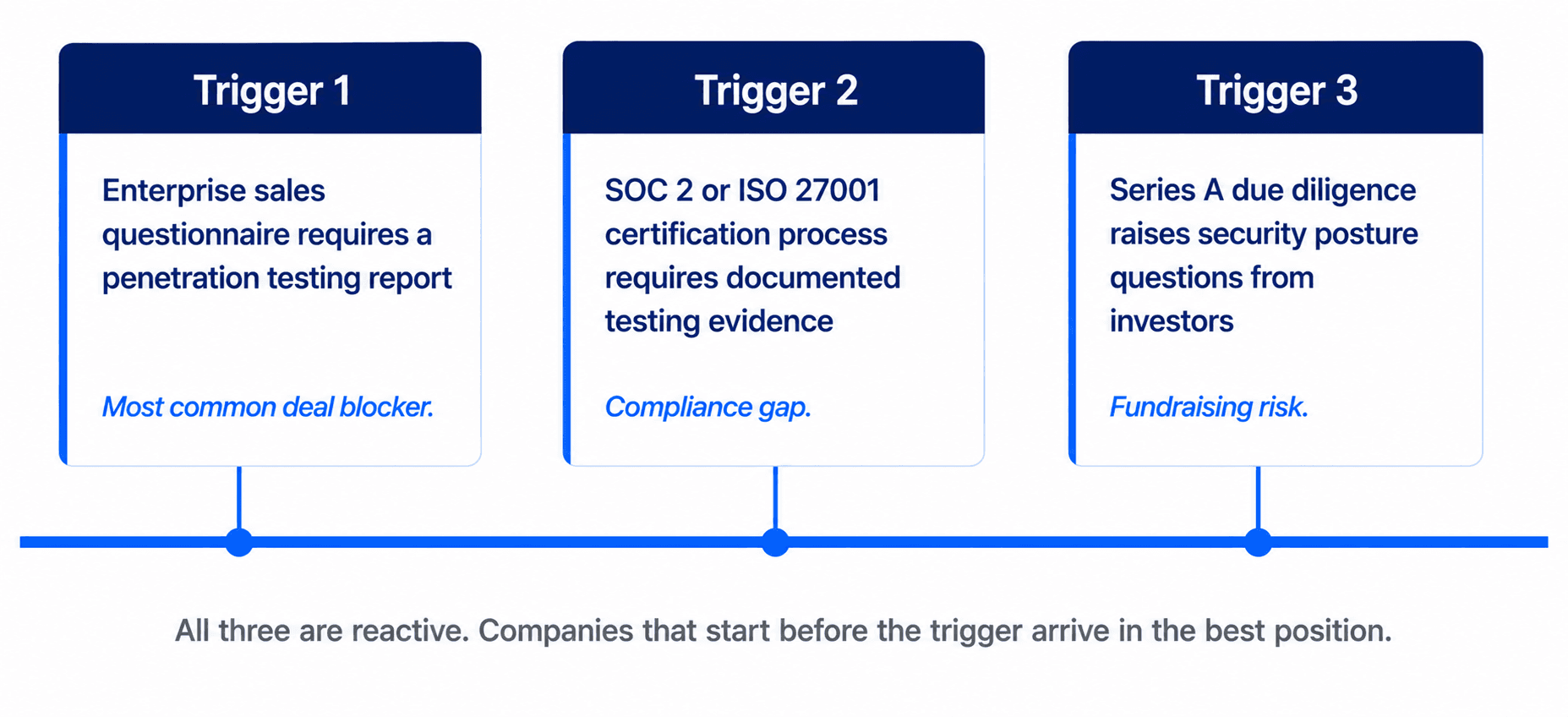
Most SaaS founders do not start security testing because they woke up one morning and decided it was time. They start because something forced the question. That forcing function tends to arrive at one of three points.
The first is the enterprise sales trigger. A potential customer, usually a larger organisation with a procurement process, asks for evidence of penetration testing as part of a vendor security assessment. This happens more often than founders expect, and it happens earlier than most anticipate. Enterprise buyers have security checklists, and a missing pentest report is a common reason deals slow down or stall entirely.
The second is the compliance trigger. A SaaS company pursuing SOC 2 Type II, ISO 27001, or PCI-DSS certification will encounter penetration testing requirements during the certification process. These frameworks do not just recommend testing. They require documented evidence of it. Starting a penetration testing programme three weeks before an audit is not a comfortable position.
The third is the fundraising trigger. Investors, particularly at Series A and beyond, are increasingly asking about security posture as part of due diligence. A clean security programme and a recent penetration testing report are assets in that conversation. Their absence is a question mark.
All three triggers are reactive. The companies that do best in each of these situations are the ones that started their security testing programme before the trigger arrived, not in response to it.
When Is Actually the Right Time for a SaaS Startup
The honest answer is earlier than most founders think, and the threshold is not technical maturity. It is customer data.
The moment a SaaS product is handling data that belongs to other people, whether that is personal information, financial records, health data, or business-sensitive content, the risk profile of a security failure has changed. It is no longer just a product problem. It is a customer problem, a contractual problem, and potentially a regulatory problem.
A useful rule of thumb is this: if a breach would require telling a customer, it is time to have a security testing programme in place.
For most SaaS startups, that point arrives earlier than the Series A. It arrives when the first paying customer signs up and hands over data they expect to be protected.
This does not mean the programme needs to be large or expensive. It means it needs to exist, be documented, and be capable of producing evidence when a customer or auditor asks for it. A well-scoped penetration testing engagement focused on the core product surface is often enough to begin. The programme grows as the product grows. Capture The Bug structures its engagements to match where a company actually is, not where a traditional annual pentest model assumes it should be. For a startup with a focused product surface, that means a proportionate engagement that delivers real findings and real documentation without the overhead of an enterprise-scale programme.
What PTaaS Actually Costs for a SaaS Startup
Penetration testing pricing is one of the least transparent corners of the security industry. Quotes vary enormously, and without context they are almost impossible to evaluate. A useful frame is to understand what drives the cost, which makes it much easier to assess whether a quote reflects the engagement you actually need.
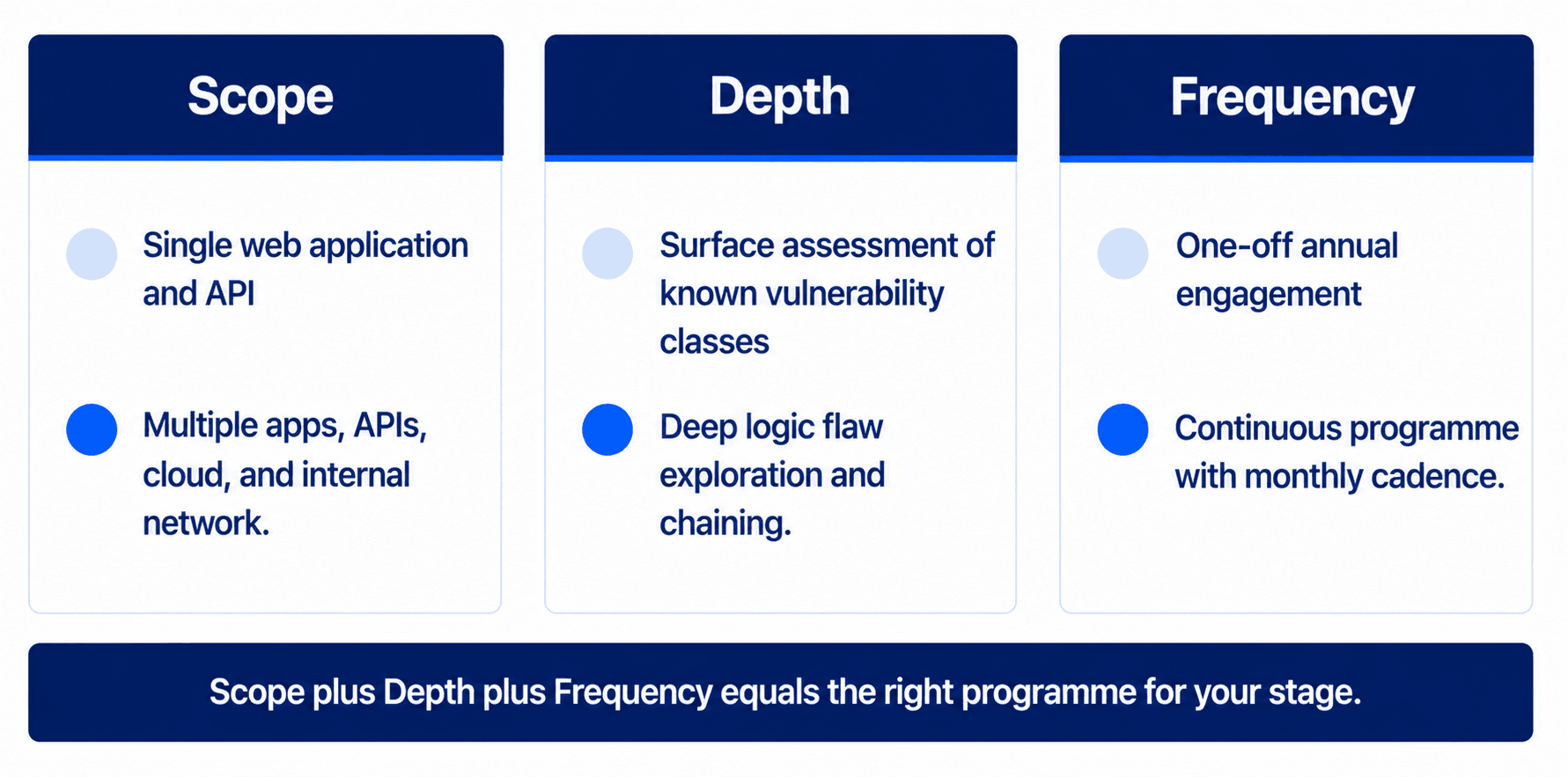
The primary cost drivers in a penetration testing engagement are scope, depth, and frequency.
Scope refers to what is being tested. A single web application with a defined set of endpoints costs less than a broad test covering multiple applications, APIs, internal network access, and cloud infrastructure. For an early-stage SaaS company, the scope is usually the core product: the web application, the API layer, and the authentication system. That is a contained and manageable scope.
Depth refers to how thoroughly the testing is conducted. A surface-level assessment that flags known vulnerability classes is faster and cheaper than a deep engagement that explores logic flaws, chaining vulnerabilities, and business-specific attack paths. Both have value, but they serve different purposes. For a startup without an existing security programme, a thorough initial assessment of the core product surface is typically the right starting point.
Frequency refers to how often testing occurs. Traditional penetration testing is priced as a one-off engagement. PTaaS is structured differently. Rather than one large annual test, a continuous model distributes testing activity across the year, which produces more current findings, better remediation tracking, and a documentation trail that supports ongoing compliance requirements.
In practical terms, a focused initial penetration testing engagement for an early-stage SaaS company typically falls in the range of several thousand dollars for a well-scoped assessment of a single application. A continuous PTaaS programme is structured differently, often with a monthly or quarterly model that scales with the product and generates ongoing evidence rather than a single point-in-time report.
What companies frequently underestimate is the cost of not having documentation when they need it. Losing an enterprise deal because a security questionnaire could not be answered, or delaying a SOC 2 audit because there is no penetration testing evidence, has a cost that can far exceed the price of the testing itself. Capture The Bug's penetration testing services are structured to be accessible at the startup stage while scaling appropriately as the company grows.
What a First PTaaS Engagement Looks Like
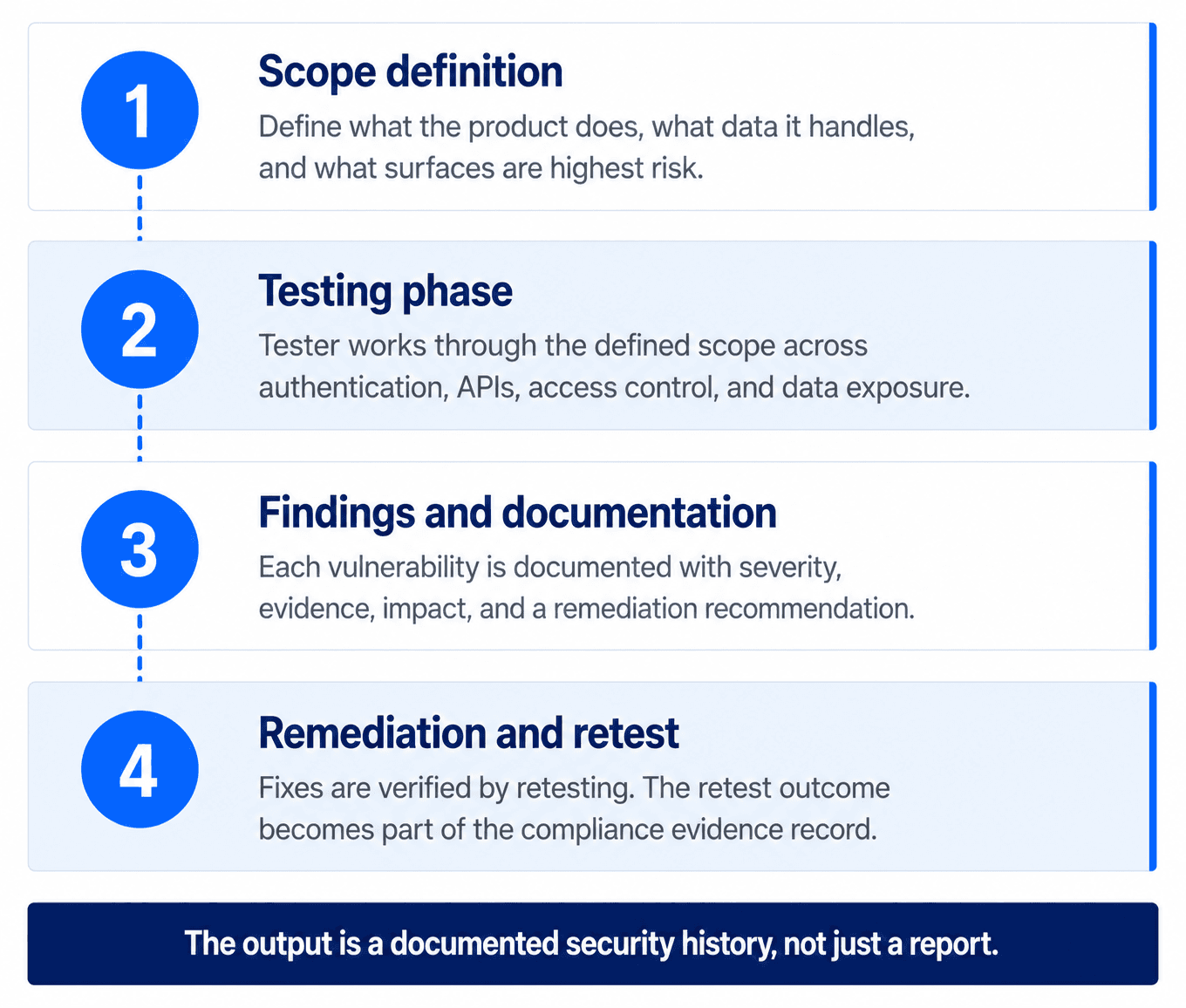
For a SaaS startup starting a security testing programme for the first time, the process typically follows a consistent pattern.
The engagement begins with scope definition. This is a conversation about what the product does, what data it handles, which surfaces are customer-facing, and what the highest-risk areas are likely to be. For most early-stage SaaS companies, this means the web application, the API, the authentication and session management layer, and any integrations that touch sensitive data.
The testing phase involves a tester working through the defined scope to identify vulnerabilities. For a web application, this covers the standard categories: injection vulnerabilities, authentication weaknesses, access control issues, data exposure risks, and configuration problems. The depth of the engagement determines how thoroughly each category is explored.
Findings are documented with severity ratings, detailed descriptions of the vulnerability, evidence of the issue, and recommendations for remediation. This is where the documentation value becomes concrete. A well-written finding is something a developer can act on and an auditor can evaluate.
Remediation and retesting close the loop. Once the development team has addressed the identified issues, a retest confirms the fixes are effective. The retest findings become part of the documentation record, which is exactly the kind of evidence that SOC 2, ISO 27001, and PCI-DSS auditors expect to see. The output is not just a report. It is the beginning of a documented security history for the product. That history becomes more valuable with every subsequent engagement, because it demonstrates that security is a continuous practice rather than a one-time exercise.
The Real Cost of Starting Late
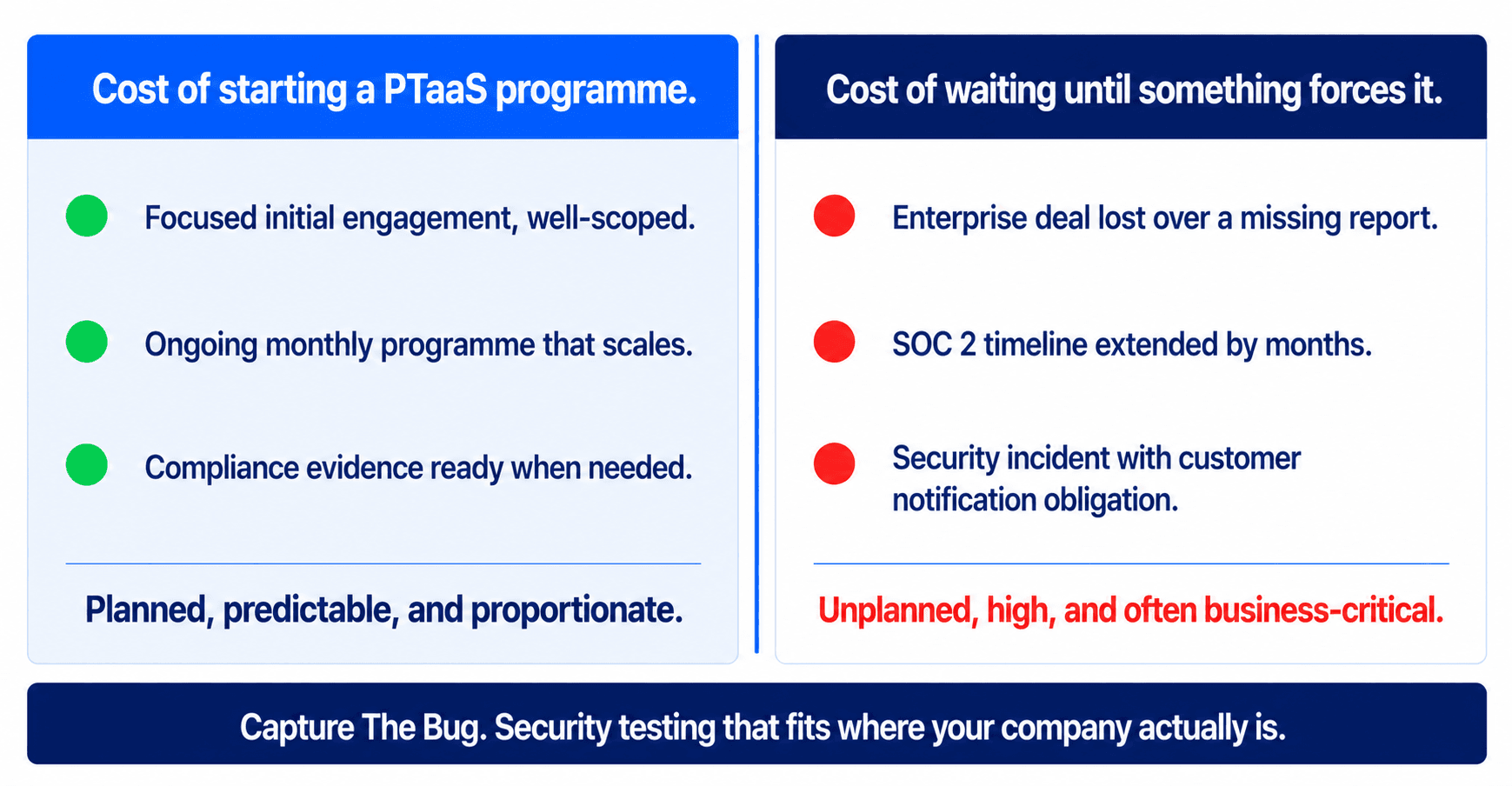
There is a version of the cost calculation that most founders do not run because the costs are not on a quote. They are in the consequences.
A deal lost because a prospect's security team found the answer "we don't have a penetration testing report" unacceptable has a cost. It rarely shows up as a line item, but it is real. Enterprise sales cycles are long and the cost of re-entering one that stalled over a security gap is measured in months of work.
A compliance certification delayed because penetration testing evidence is missing has a cost. The timeline for SOC 2 Type II is typically twelve months from the start of the observation period. If testing evidence is missing for part of that period, the certification timeline extends. That extension has a cost for every business decision waiting on the certification.
A security incident that occurred in a system that was never tested has a cost that includes the incident itself, the customer notification obligation, the potential regulatory exposure, and the reputational impact that follows.
None of these costs are hypothetical for SaaS companies. They are documented, common, and almost always larger than the cost of the testing programme that would have prevented them. Starting a penetration testing programme as a SaaS startup is not a luxury decision for companies that can afford it. It is a timing decision about when to carry a known risk versus when to begin managing it. The companies that treat it as a timing decision, and make that call early, consistently end up in a better position at every subsequent stage. Capture The Bug works with SaaS startups across ANZ and the US to build that programme from the ground up, scoped appropriately for where the company is and structured to grow as the product does. More on how that works is at our services page.
Frequently Asked Questions
When should a SaaS startup get its first penetration test?
The practical threshold is when the product is handling data that belongs to customers and a breach would require notifying them. For most SaaS products, that point arrives with the first paying customer. A well-scoped initial engagement focused on the core product surface is typically the right starting point at that stage.
How much does penetration testing cost for a SaaS startup?
Cost depends primarily on scope, depth, and frequency. A focused initial assessment of a single web application and API typically falls in the range of several thousand dollars. A continuous PTaaS programme is structured differently and scales with the product. The more relevant cost question for most startups is what a deal lost or a compliance delay due to missing testing documentation actually costs, which is usually much higher.
What is the difference between a one-off pentest and PTaaS for a startup?
A one-off penetration test produces a point-in-time report. PTaaS is a continuous programme that generates ongoing findings, tracks remediation, and produces current evidence at any point in the year. For startups pursuing compliance certifications or selling to enterprise customers, the continuous documentation trail is often more valuable than the findings themselves.
Does a SaaS startup need penetration testing before Series A?
Increasingly, yes. Investors at Series A and beyond are asking about security posture as part of due diligence. A clean security programme with documented penetration testing evidence is an asset in that conversation. More practically, if the company is targeting enterprise customers, a penetration testing report is often required before a deal can close regardless of funding stage.
What does a SaaS startup's first PTaaS engagement actually cover?
A first engagement typically covers the web application, the API layer, the authentication and session management system, and any integrations that handle sensitive data. The scope is defined based on what the product does and where the highest-risk areas are. Findings are documented with severity ratings and remediation guidance, and a retest confirms that issues have been addressed.