
How to Evaluate a Vulnerability Disclosure Program Before You Launch One
There is a moment in most growing SaaS companies when someone, usually a CTO or a security-minded founder, says it is time to open a front door for security researchers. A vulnerability disclosure program, commonly called a VDP, is that front door. It tells the security community that if they find something in your product, there is a legitimate, safe, and structured way to report it.
The instinct is right. A VDP is a mature security practice and, increasingly, a signal that enterprise buyers and compliance auditors look for. But the instinct to launch quickly, to just get something live, is where most companies run into problems.
A VDP that is not properly designed does not just fail to deliver value. It creates obligations the organisation is not prepared to meet, generates researcher frustration that can spill into public disclosure, and in some cases creates legal ambiguity that puts both the company and the researcher in a difficult position.
Capture The Bug has worked with hundreds of organisations across Australia, New Zealand, and the United States on their security programmes. The companies that launch effective VDPs share one characteristic: they evaluated the programme rigorously before they launched it, not after. This is the evaluation framework they used.
Start with the Question the Program Is Designed to Answer
Before any technical or operational decision is made about a VDP, the organisation needs to answer one foundational question: what problem is this programme trying to solve?
That question sounds obvious. It rarely gets the attention it deserves.
A VDP designed primarily to satisfy a compliance requirement looks very different from one designed to genuinely extend the organisation's security coverage. A VDP designed to build a relationship with the security research community requires different resources than one designed simply to provide a structured inbound channel for reports.
The answer to this question determines the scope of the programme, the resources allocated to it, the response commitments made, and the way it is communicated publicly. Starting without clarity on purpose means making design decisions that pull in conflicting directions and ending up with a programme that does not do any of its jobs particularly well.
Capture The Bug recommends that organisations write a one-paragraph purpose statement for their VDP before anything else is decided. That statement should explain who the programme is for, what it is designed to find, and what the organisation commits to doing with what it receives. Everything that follows is a test of whether the programme design actually delivers on that statement.
Evaluate Your Internal Readiness to Receive and Respond
A vulnerability disclosure program is a commitment. When a researcher submits a report, the organisation on the other end has an obligation. That obligation is not just ethical. It is reputational.
Researchers talk to each other. A company that acknowledges receipt and then goes silent for three weeks, or that responds with a legal threat when a legitimate security issue is reported, becomes known in the research community as a programme to avoid. The consequence is that future researchers, the ones who might find the next serious vulnerability, take their findings elsewhere or publish them without coordination.
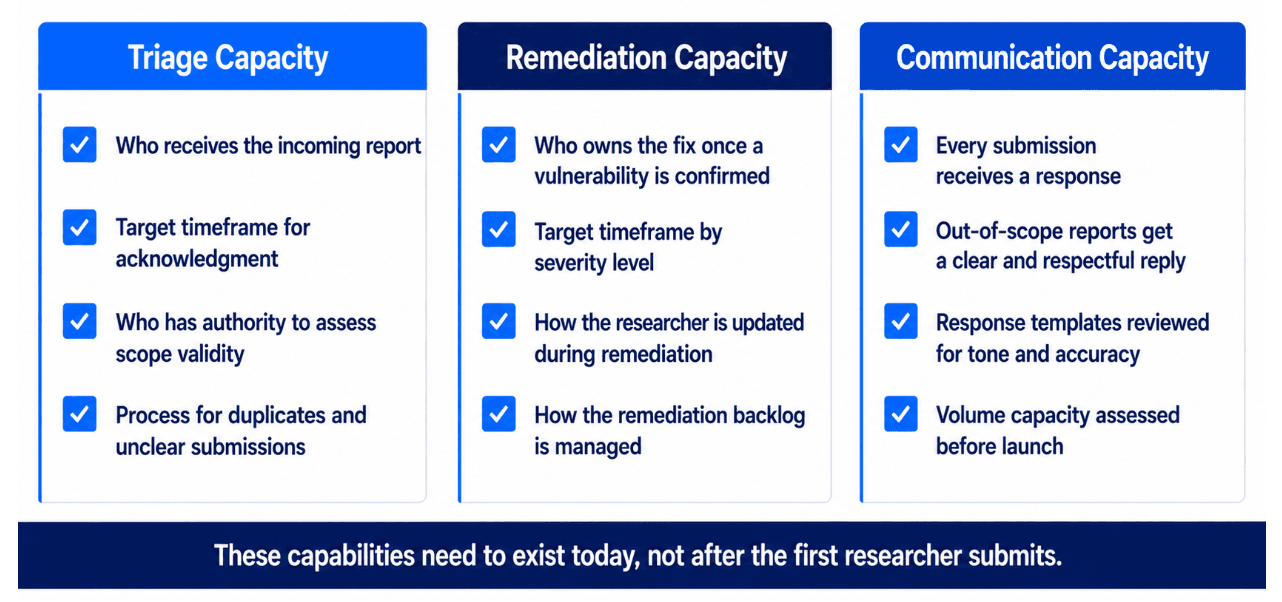
Before launching, an organisation needs to evaluate whether it has the internal capacity to handle what a VDP will generate. The evaluation should cover several specific areas.
The first is triage capacity. Who receives the incoming report? What is the target timeframe for initial acknowledgment? Who has the authority and expertise to assess whether a submission represents a genuine vulnerability in scope? How does the triage process handle duplicate submissions, out-of-scope reports, and reports that are unclear or incomplete?
The second is remediation capacity. Once a valid vulnerability is confirmed, who owns the fix? What is the target timeframe for remediation across different severity levels? How is the researcher kept informed during that process? A VDP without a connected remediation workflow produces a backlog of confirmed vulnerabilities with no clear path to resolution.
The third is communication capacity. Every researcher who submits a report deserves a response. Even a submission that is out of scope, invalid, or a duplicate should receive a clear, respectful, and timely reply. Organisations that underestimate the communication overhead of a VDP typically launch with enthusiasm and then quietly stop responding as volume increases.
The honest evaluation question is not whether the organisation wants to have these capabilities. It is whether they exist today, right now, at the level the programme will require from day one.
Review the Legal Framework Before It Becomes a Problem
One of the most common mistakes organisations make when launching a VDP is treating the legal language as a formality, something to be drafted quickly and posted alongside the technical scope.
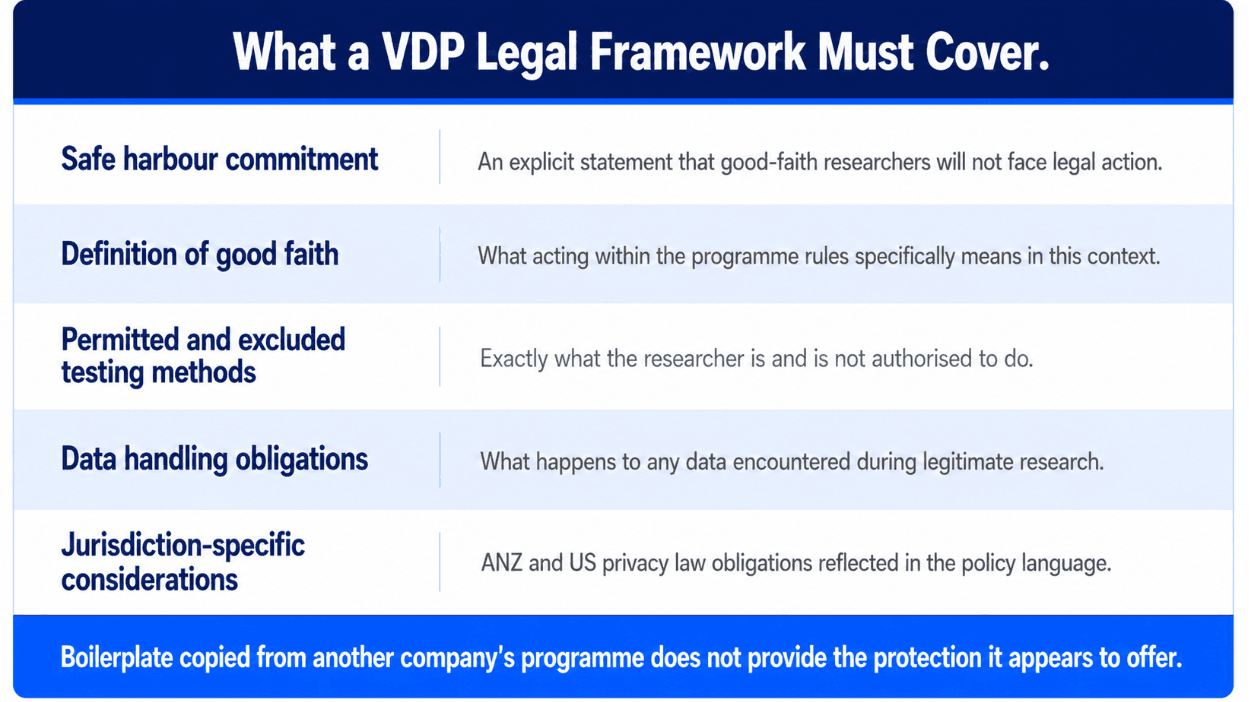
The legal framework of a VDP is the document that tells a researcher whether they are safe to do the work you are inviting them to do. It needs to provide a clear commitment that the organisation will not pursue legal action against researchers who act in good faith and within the defined scope. Without that commitment, researchers operating in good faith have no protection, and the most skilled and careful researchers will choose not to engage.
The legal review should cover several specific points. The safe harbour language must be explicit and unambiguous. It must define what acting in good faith means in the context of this programme. It must define what is considered within scope and, importantly, what testing methods are not permitted regardless of scope. It must address what happens to data the researcher encounters during their research and what the organisation's obligations are regarding that data.
In the Australian and New Zealand context, there are specific considerations around the Computer Fraud and Abuse Act equivalents and the privacy obligations that arise when a researcher encounters personal data during a legitimate security assessment. The legal framework of the VDP needs to address these rather than leaving them to interpretation.
An organisation that launches a VDP with boilerplate legal language copied from another company's programme is not protected by that language. The legal framework needs to reflect the specific programme, the specific scope, and the specific jurisdiction.
Define Scope with Precision, Not Generosity
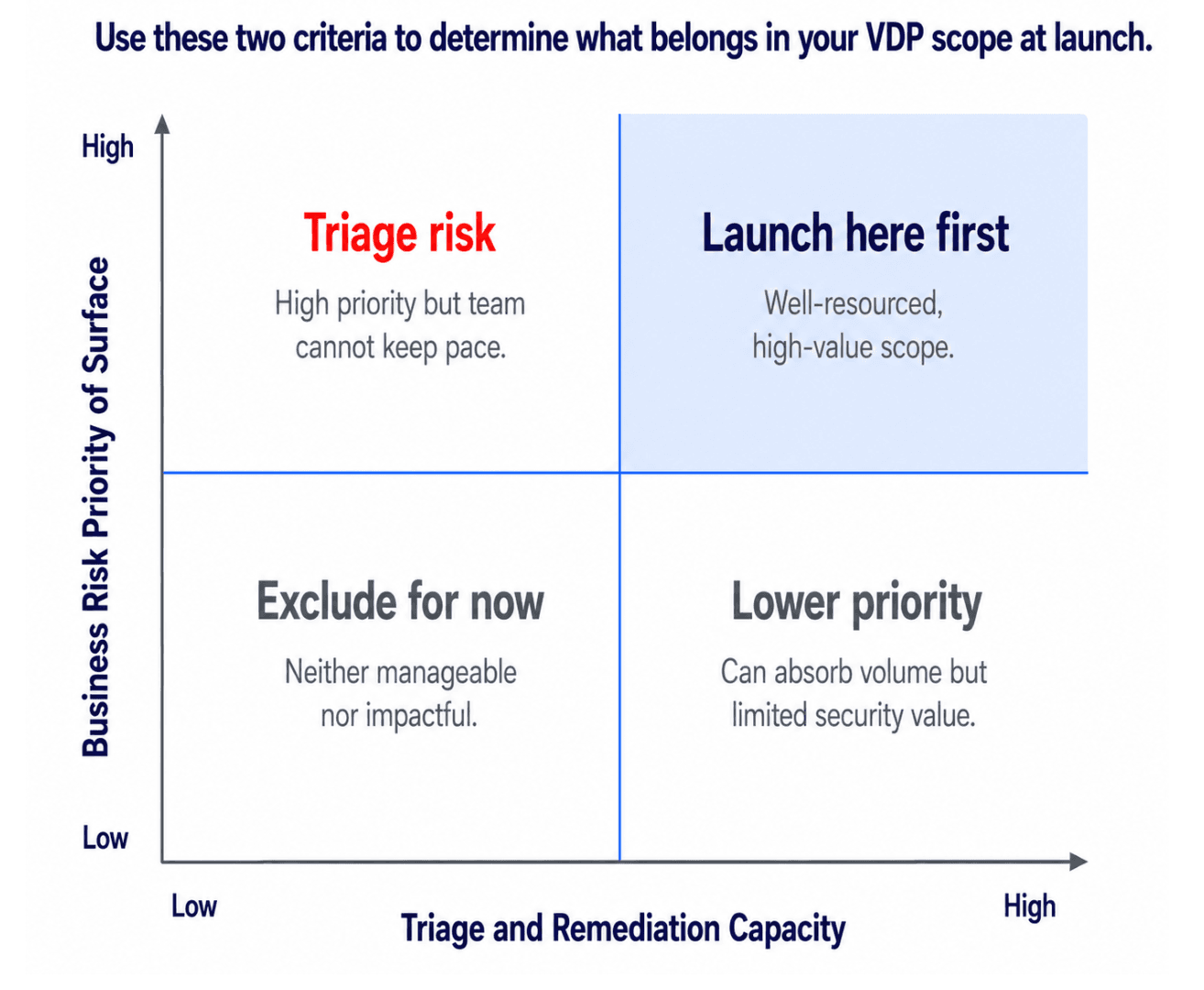
Scope is where most VDPs create operational problems for themselves. The common tendency is to launch with a broad scope in the belief that a wider surface area means more valuable findings. In practice, a scope that is broader than the organisation's triage and remediation capacity can handle produces a flood of submissions, most of which cannot be acted on at the pace researchers expect.
The scope of a VDP should be defined by two criteria. The first is organisational capacity: what can the team actually triage, confirm, and remediate within a timeframe that respects the researcher? The second is risk priority: which surfaces, if compromised, would have the highest impact on customers and the business?
The intersection of those two criteria produces a scope that is both useful and manageable. It is far better to launch with a narrow, well-resourced scope and expand it over time than to launch with an ambitious scope and fail to keep pace with the submissions it generates.
Scope should specify which domains, applications, and environments are included. It should specify which testing types are permitted and which are not. It should specify any assets that are explicitly excluded even if they fall within the general surface area of the product. Understanding what rigorous scoping looks like in practice is part of what Capture The Bug works through with organisations preparing their security programmes. The penetration testing methodology that informs how scope is defined for testing engagements is documented at capturethebug.xyz/Services/penetration-testing.
Establish What You Will and Will Not Reward
A VDP and a bug bounty programme are different things. A VDP is a structured channel for receiving and acting on vulnerability reports. A bug bounty programme adds a financial reward component for valid, in-scope findings.
Not every organisation is ready for a bug bounty programme, and launching one prematurely creates a set of obligations that can be difficult to manage. But even a VDP without financial rewards needs a clear policy on what researchers can expect to receive in return for a valid report.
At a minimum, the programme should offer clear acknowledgment, timely communication throughout the remediation process, and credit in the form of a public acknowledgment or hall of fame listing for researchers who want it. These are not expensive commitments, but they need to be made explicitly and then delivered consistently. The evaluation question here is straightforward: what is the organisation prepared to offer, and is it prepared to deliver that consistently at whatever volume the programme generates? The answer to that question should be reflected in the published programme policy rather than left to individual judgement at the time of each submission.
Test the Programme Before It Goes Public
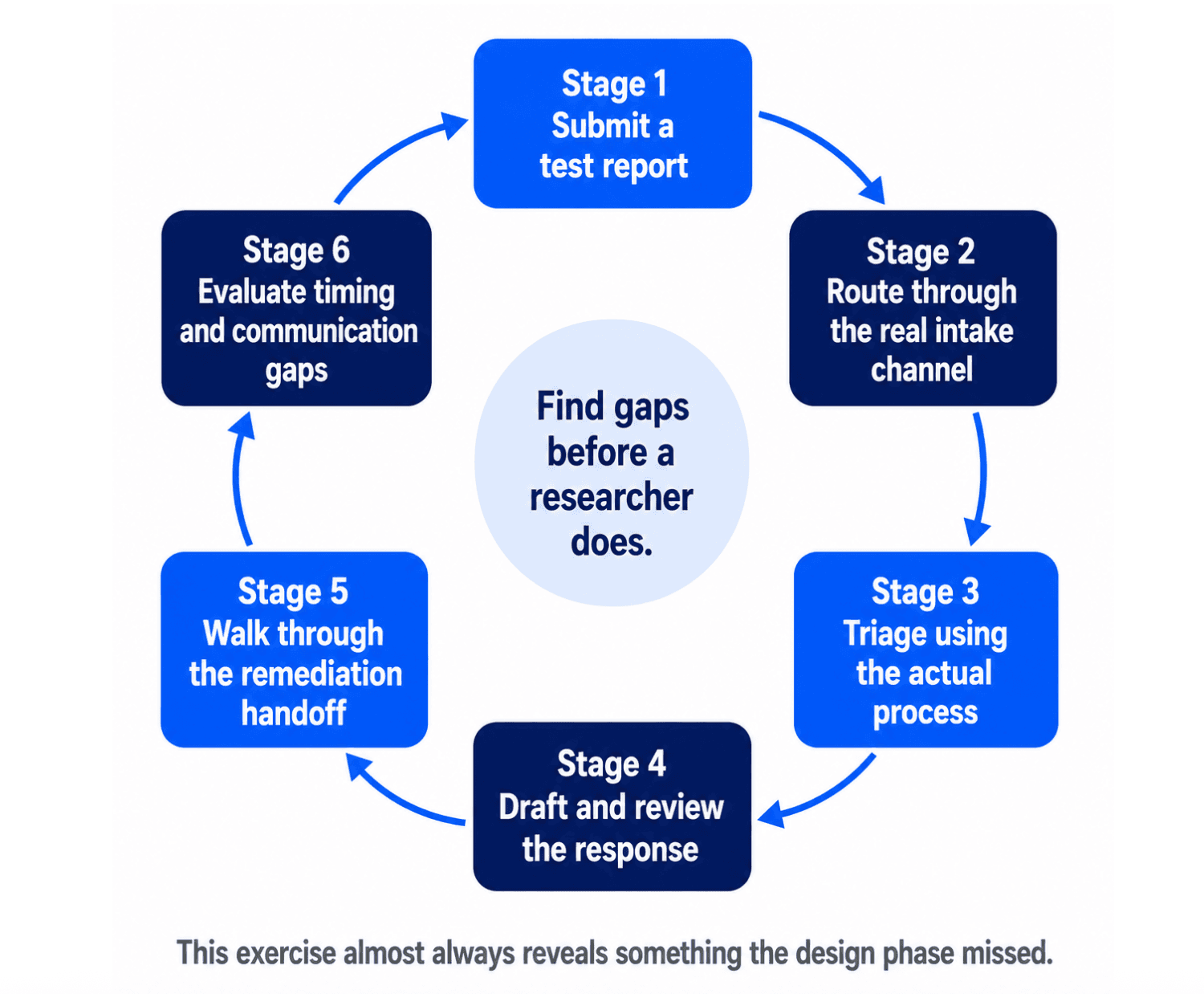
A VDP that has not been internally tested is a programme being tested by the researchers who submit to it. That is not a position any organisation should want to be in.
Before a VDP goes live, the organisation should run a structured internal exercise that simulates the full lifecycle of a submission. A test report should be submitted through the same channel researchers will use. It should be triaged using the actual triage process. A response should be drafted and reviewed. The remediation workflow should be walked through. The communication touchpoints should be evaluated for clarity and timeliness.
This exercise almost always reveals gaps that were not visible during the design phase. Notification routing that does not work as expected. Response templates that are technically accurate but come across as dismissive. Remediation handoffs that require more coordination than anticipated. Finding those gaps before the first real researcher submission is substantially less damaging than finding them after.
The same principle applies to the security testing that underpins the programme. A VDP launched without a baseline understanding of what vulnerabilities already exist in the in-scope surface is a programme accepting reports about conditions the organisation has not yet assessed. Penetration testing of the assets being placed in scope gives the security team context to evaluate submissions accurately and prioritise responses appropriately. Capture The Bug's penetration testing services are designed to provide exactly that baseline, ahead of programmes like these going live. More on how that works is at capturethebug.xyz/Services/penetration-testing.
The Launch Decision
A well-evaluated VDP is not a perfect VDP. It is a programme where the gaps are known before launch rather than discovered through them.
The organisations that run effective disclosure programmes are not the ones with the most sophisticated policies. They are the ones that went into the launch with an honest assessment of their own readiness, defined a scope they could actually service, built a legal framework that protected researchers acting in good faith, and committed to communication standards they could sustain.
The security research community has a long memory. A programme that is modest in scope but delivers on every commitment it makes builds a reputation that earns increasingly valuable researcher engagement over time. A programme that over-promises and under-delivers earns the opposite. Capture The Bug works with companies across ANZ and the US building security programmes that hold up under real operational conditions. A VDP is one part of that picture. The security testing infrastructure that supports it is another.
Plan Your Annual Pentesting Strategy the Right Way
Learn how modern SaaS companies structure pentesting across the year to reduce risk, stay compliant, and avoid last-minute panic before audits.

Frequently Asked Questions
What is the difference between a vulnerability disclosure program and a bug bounty program?
A vulnerability disclosure program (VDP) is a structured channel for receiving and acting on security vulnerability reports. It provides a safe and legitimate path for researchers to report what they find. A bug bounty programme adds financial rewards for valid, in-scope findings. Both require clear policies, defined scope, and internal processes to handle submissions. A VDP is typically the right starting point for organisations that are building their security programme rather than scaling an existing one.
Do you need to complete a penetration test before launching a VDP?
It is strongly advisable. A penetration test of the assets being placed in scope gives the security team a baseline understanding of what vulnerabilities already exist. Without that baseline, the team reviewing incoming researcher submissions has no context for assessing whether a finding is new, already known, or related to an issue already in remediation. A baseline test also ensures the organisation is not publicly inviting researchers to submit reports about conditions it has not yet assessed internally.
What should a VDP safe harbour statement include?
A safe harbour statement should explicitly commit that the organisation will not pursue legal action against researchers who act in good faith and stay within the defined scope. It should define what acting in good faith means in the context of the programme. It should address what happens to any data the researcher encounters during legitimate research. And it should be specific to the programme and jurisdiction rather than copied from generic templates. Boilerplate language does not provide the protection it appears to offer.
How narrow should the scope of a VDP be at launch?
The scope should reflect two criteria: the capacity of the team to triage and respond to submissions, and the surfaces that represent the highest risk to customers and the business if compromised. It is far better to launch with a narrow, well-resourced scope and expand over time than to launch with a broad scope and fail to keep pace with submission volume. Researchers are experienced evaluators of programme quality, and an organisation that cannot respond promptly will find that researchers stop submitting.
How should an organisation handle a researcher who reports a critical vulnerability?
A critical finding should trigger immediate escalation to the appropriate technical and security leadership. The researcher should receive an acknowledgment within hours, not days. Communication should continue at regular intervals throughout the remediation process even if there is nothing new to report. The researcher should be informed when the fix is confirmed. If the organisation needs time before public disclosure, that conversation with the researcher should happen early, clearly, and respectfully. Coordinated disclosure handled well builds researcher relationships. Handled poorly, it results in uncoordinated public disclosure.