Two Models, One Question Every Security Leader Asks
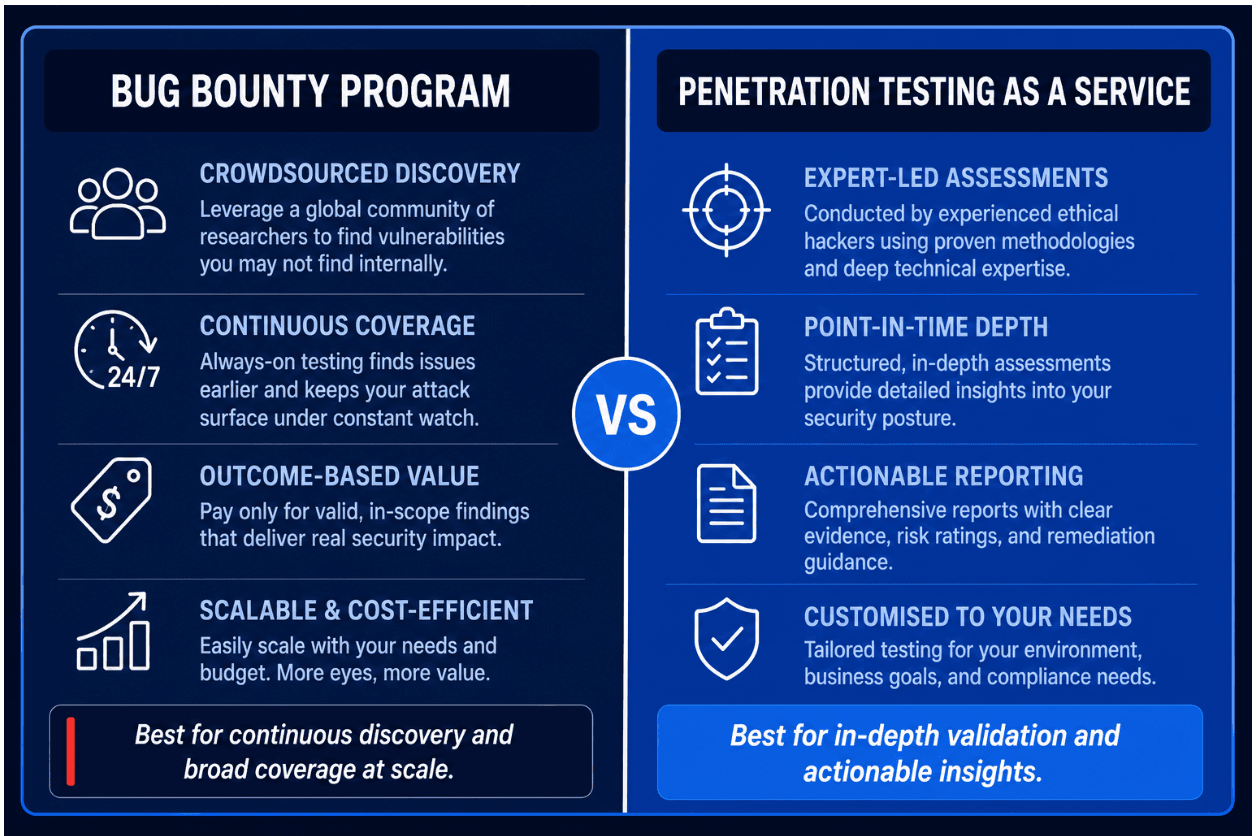
At some point in the growth of almost every technology company, a security leader or founder sits down and asks the same question. Should we run a bug bounty program, bring in a penetration testing team, or try to do both?
It is a reasonable question. Both models are positioned as ways to find vulnerabilities before attackers do. Both carry real credibility in the security community. And both require a meaningful investment of time, money, and internal resources to run well.
The answer, however, is rarely what the marketing around either model suggests. The right choice depends almost entirely on the stage of the business, the maturity of the security programme, the regulatory environment the company operates in, and what kind of evidence leadership actually needs to make decisions and satisfy external stakeholders.
Capture The Bug works with companies across Australia, New Zealand, and the United States at different stages of this decision. What follows is an honest, clear-eyed look at what each model actually delivers, where each one falls short, and how to think about ROI in a way that goes beyond the price tag on a single engagement.
What a Bug Bounty Program Actually Is
A bug bounty program is an open invitation to external security researchers to find and report vulnerabilities in a company's systems in exchange for a monetary reward. The reward is typically tied to the severity of the finding, with critical vulnerabilities commanding the highest payouts.
Bug bounty programs gained significant traction over the past decade as major technology companies began publishing their programs publicly and paying out substantial amounts for significant findings. The model has genuine appeal. It draws on a large, distributed pool of researchers with diverse skill sets, it operates continuously rather than at scheduled intervals, and it theoretically scales with the complexity of the target environment.
In practice, the reality is more nuanced. Bug bounty programs work well for companies with mature, well-tested security postures that have already addressed the most significant vulnerabilities through structured testing. At that stage, a bug bounty program is an effective way to cast a wide net and catch the edge cases that a scoped engagement might not reach.
For companies that have not yet conducted rigorous, objective-based security testing, a bug bounty program introduces a different set of problems. Researchers gravitate toward high-payout targets and familiar vulnerability classes. The coverage is uneven because researchers self-select the areas they want to investigate rather than following a structured scope. And the company has no guarantee of what has actually been tested versus what has simply not attracted researcher attention.
There is also the operational overhead to consider. Managing a bug bounty program means triaging every incoming report, validating duplicates, communicating with researchers, managing payouts, and maintaining programme infrastructure. For organisations without a dedicated internal security team, this overhead is substantial.
What Penetration Testing as a Service Actually Delivers
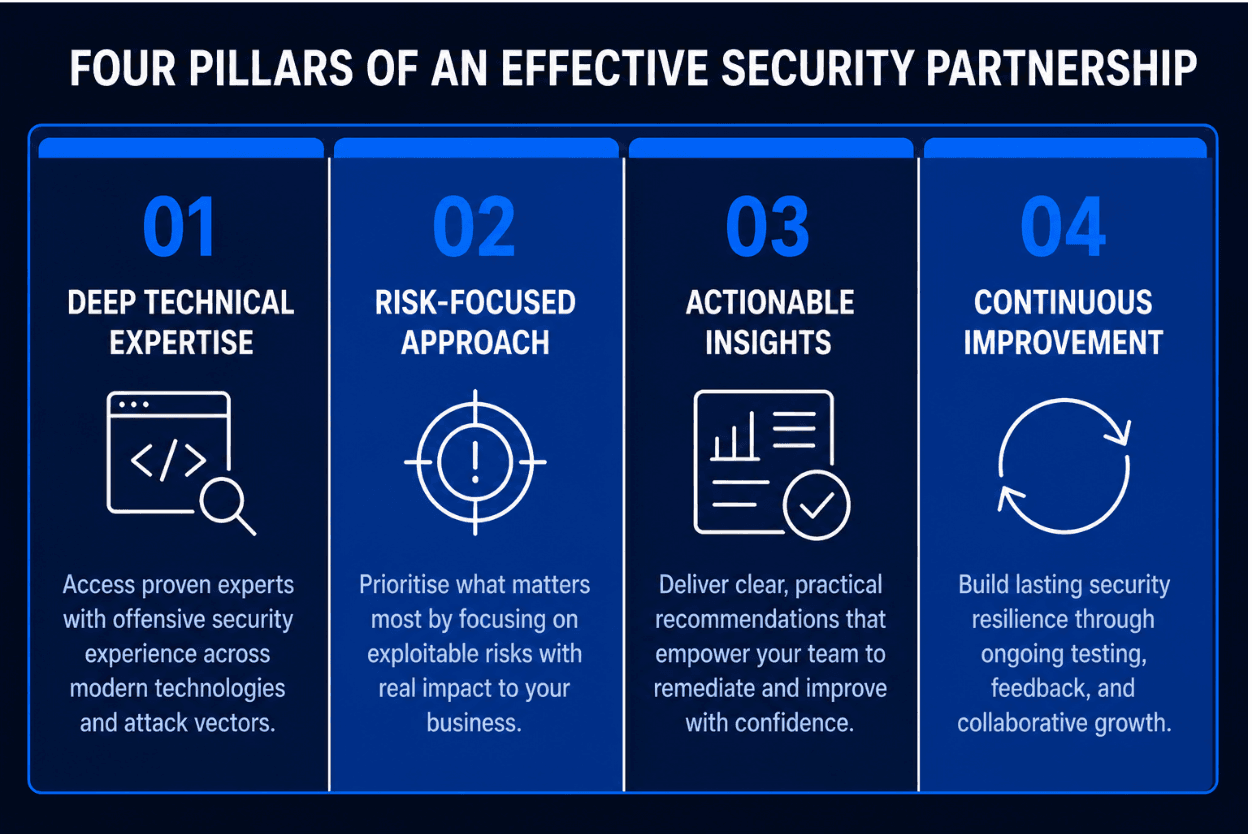
Penetration Testing as a Service is a structured, ongoing security testing model where a specialist provider conducts expert-led penetration tests against agreed targets at defined intervals, with consistent methodology, documented evidence, and verified remediation support.
The PTaaS model sits between the rigidity of a one-off annual test and the unpredictability of a bug bounty program. It provides the depth and structure of a formal penetration test with the frequency and continuity that growing businesses need to keep pace with the changes in their environment.
What separates PTaaS from a bug bounty program in practical terms comes down to four things:
First, coverage is guaranteed. A penetration test is scoped to cover specific systems, applications, and environments fully. The tester does not move on until the agreed scope has been assessed. A bug bounty researcher moves on whenever a more interesting or more rewarding target presents itself.
Second, the testing is objective-based. Capture The Bug designs every engagement around what an attacker would actually try to achieve in the specific environment, not just what vulnerability categories exist. This means the findings reflect real attack paths rather than isolated technical issues.
Third, the output is structured and actionable. A penetration test produces a report with documented findings, verified evidence, severity ratings in business context, and specific remediation guidance. That report is usable for board presentations, regulatory submissions, and vendor security reviews. Bug bounty reports arrive in whatever format the researcher chooses to write them.
Fourth, the engagement includes remediation support and retesting. Finding a vulnerability is only the beginning. Confirming that the fix actually closes the attack path requires a follow-up verification by the same team that found it. Bug bounty programs do not routinely provide this.
Where Each Model Delivers and Where Each One Falls Short
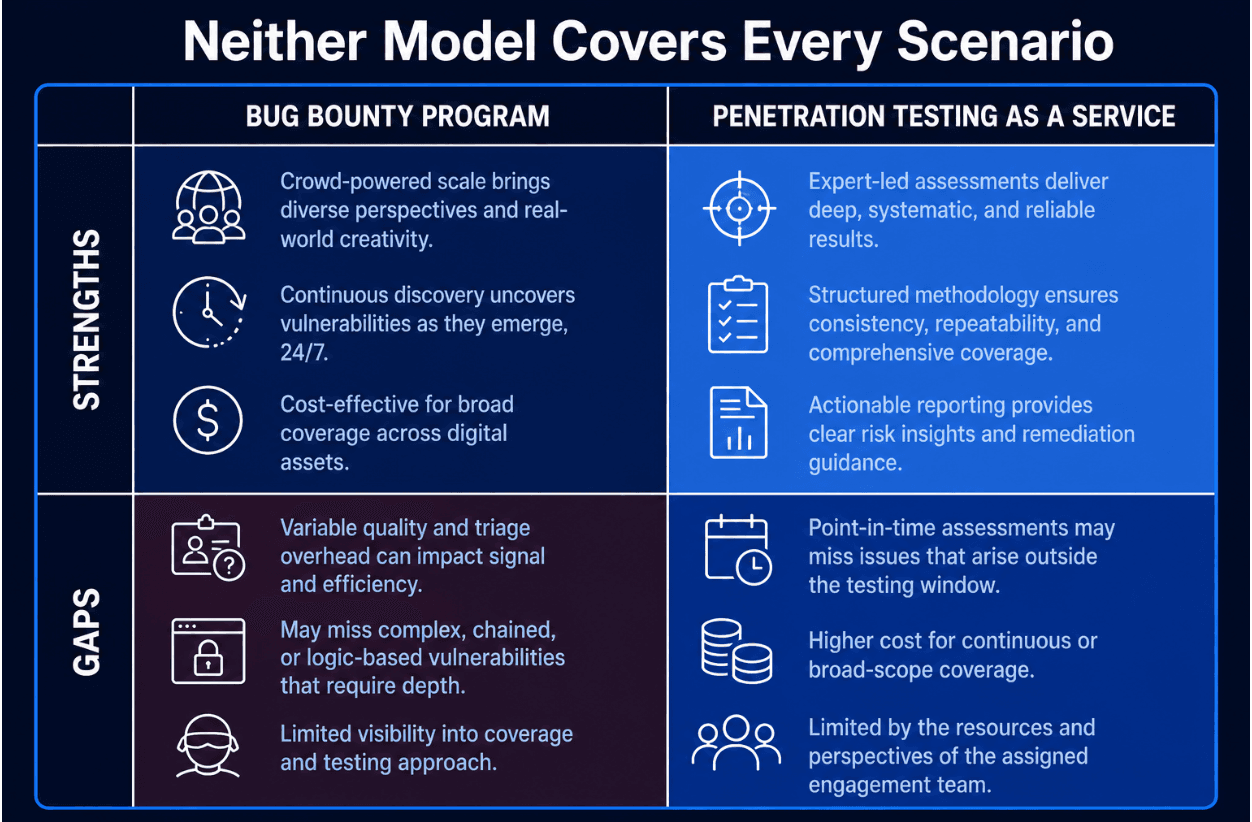
Bug bounty programs deliver genuine value in specific circumstances. When a company has an existing, mature security programme and wants to extend its coverage beyond what a scoped engagement can reach, a bug bounty programme adds a meaningful layer. When a company wants to build credibility with the security research community and demonstrate openness to external scrutiny, a public program serves that purpose well.
Where bug bounty programs fall short is in providing the kind of evidence that regulators and enterprise clients require. An unstructured stream of researcher reports does not constitute documented security testing under APRA CPS 234 or comparable frameworks in New Zealand and the United States. A board asking for evidence of security due diligence cannot be satisfied with a payout log.
Bug bounty programs also fall short when a company genuinely does not know the state of its own security posture. Sending an unknown environment to a distributed pool of researchers with no defined scope or methodology is not a substitute for a rigorous baseline assessment. It is a way of hoping that the most significant issues attract researcher attention before an attacker finds them first. PTaaS, on the other hand, is bounded by the agreed scope, which means vulnerabilities outside the scope are not reported. It requires a defined engagement window and an investment in a dedicated provider relationship.
How to Think About ROI for Each Model
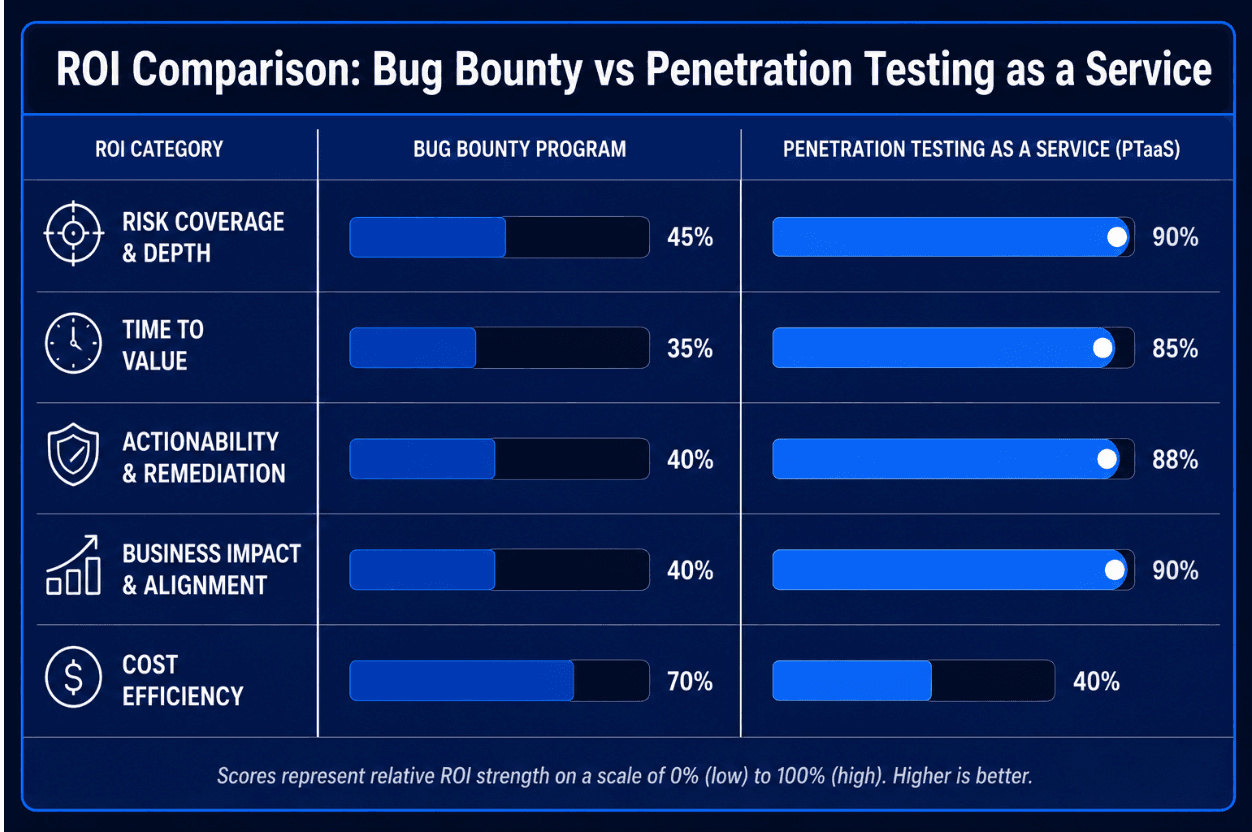
Return on investment in security is notoriously difficult to calculate directly because the primary return is the absence of something: a breach that did not happen, a regulatory sanction that was avoided, a customer relationship that was not destroyed.
What can be measured is the return on the investment in terms of the quality and usability of the outputs each model produces.
A bug bounty program that runs for twelve months and produces forty researcher reports of varying quality, covering a self-selected portion of the attack surface, with no verified remediation and no structured evidence trail, has produced outputs of limited strategic value regardless of the total payout amount.
A PTaaS engagement that covers the highest-risk areas of the environment, produces a documented report with verified findings and business context, supports remediation tracking, and delivers a retest confirming that critical issues have been resolved, has produced outputs that serve the engineering team, the board, the regulators, and the sales process. The ROI difference is not in the number of vulnerabilities found. It is in what the business can do with the findings, how quickly it can act on them, and how credibly it can demonstrate that action to the stakeholders who matter. For companies operating in regulated industries under APRA, ASIC, or US standards, a professionally delivered PTaaS engagement from a CREST-certified provider like Capture The Bug provides exactly the evidence required. The structure of these programs is outlined on our services page.
Who Should Choose Which Model and When
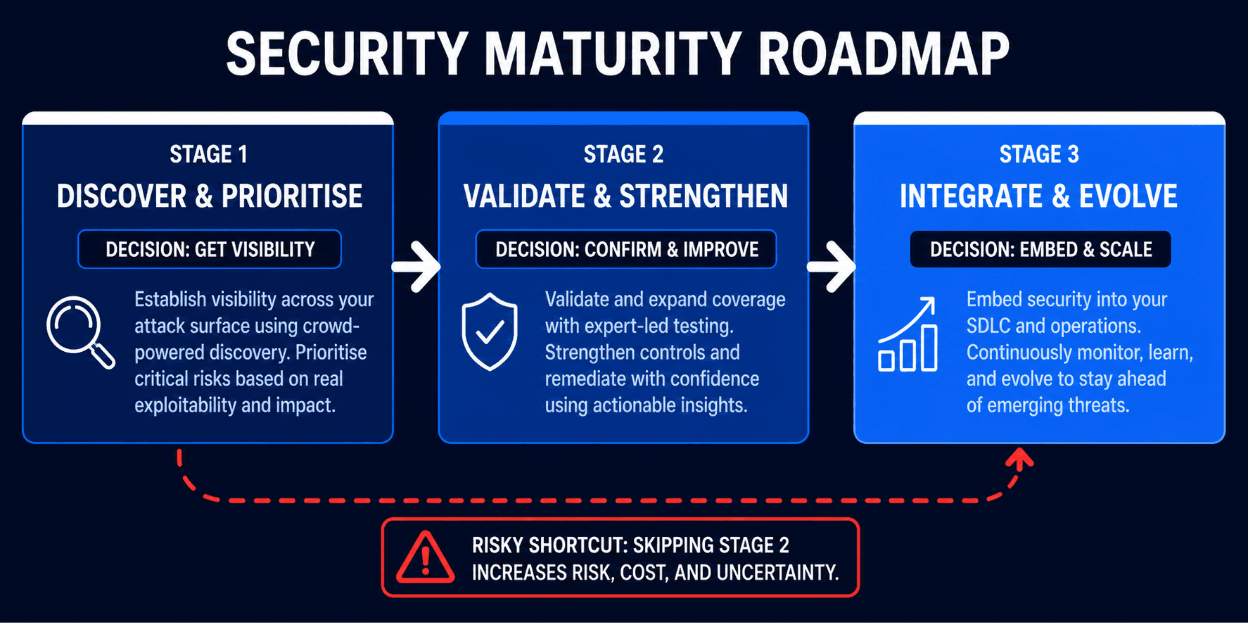
The decision between bug bounty and PTaaS is not permanent. It is a decision that should be revisited as the security programme matures.
For businesses that have not yet conducted a structured penetration test, PTaaS is the clear starting point. The priority is establishing a clear baseline understanding of the actual security posture before any other layer of testing is added. Without that baseline, additional testing layers add cost and complexity without adding proportionate clarity.
For businesses that have an established PTaaS programme and are considering adding a bug bounty layer, the combination can be powerful. The PTaaS programme provides the structured, documented backbone. The bug bounty programme extends coverage to areas outside the regular scope and draws on a broader pool of researcher perspectives.
The companies Capture The Bug sees managing security most effectively are those that treat PTaaS as the foundation and consider additional testing layers, including bug bounties, as extensions that build on top of that foundation rather than substitutes for it. A security programme built on structured, expert-led, continuously verified testing is the one that protects the business, satisfies the regulators, and wins the trust of enterprise clients. That is the return that matters most.
Plan Your Annual Pentesting Strategy the Right Way
Learn how modern SaaS companies structure pentesting across the year to reduce risk, stay compliant, and avoid last-minute panic before audits.
Frequently Asked Questions
What is the main difference between a bug bounty program and penetration testing as a service?
A bug bounty program is an open invitation to external researchers to find and report vulnerabilities in exchange for monetary rewards, with no guaranteed coverage and variable quality of output. Penetration testing as a service is a structured, expert-led engagement with defined scope, consistent methodology, documented findings, and verified remediation support. The core difference is predictability: PTaaS guarantees coverage and output quality, while bug bounty programs depend on researcher interest and self-selection.
Does a bug bounty program satisfy APRA CPS 234 security testing requirements?
No. APRA CPS 234 requires documented evidence of structured, rigorous security control testing that is proportionate to the risks an organisation carries. An unstructured stream of researcher reports from a bug bounty program does not constitute that evidence. A formally delivered penetration test from a CREST-certified provider, with documented findings, severity ratings, and a verified remediation trail, is what regulatory auditors expect to review.
Which delivers better ROI for a business that has never done formal security testing?
For businesses without a structured security baseline, penetration testing as a service delivers significantly better ROI. Bug bounty programs require researchers to self-select what they test, which means critical areas of the environment may never attract attention. A structured PTaaS engagement covers the agreed scope fully, produces actionable documented findings, and supports remediation in a way that builds a real security baseline rather than hoping researchers find the most significant issues first.
Can a company run both a bug bounty program and a PTaaS engagement at the same time?
Yes, and for mature security programmes the combination is powerful. PTaaS provides the structured, documented backbone of the security programme with guaranteed scope coverage. A bug bounty program extends coverage beyond the regular testing scope and draws on a broader pool of researcher perspectives. The key is treating PTaaS as the foundation and bug bounty as an extension built on top of it, not as alternative approaches competing for the same budget.
How does the output of a bug bounty program compare to a penetration test report for board and regulatory communication?
The outputs are significantly different in usability. A penetration test report is a structured document with documented findings, verified evidence, severity ratings in business context, and specific remediation guidance, written in a format suitable for board presentations and regulatory submissions. Bug bounty reports arrive in whatever format individual researchers choose and carry no standardised methodology or evidence trail. For organisations that need to communicate security maturity to a board, auditor, or enterprise client, a PTaaS report is the appropriate deliverable.
What makes PTaaS more predictable than a bug bounty program?
PTaaS is conducted by a defined team against an agreed scope using a consistent methodology. The business knows what will be tested, how it will be tested, and what the output will look like before the engagement begins. Bug bounty programs have no defined scope in the same sense because researchers choose where to focus their attention. This means a company running a bug bounty program may have significant areas of the environment that have never been reviewed, with no way to know what has and has not attracted researcher attention.
At what stage of security maturity should a business consider adding a bug bounty program?
Bug bounty programs add the most value when a business already has a mature security programme with a solid track record of structured penetration testing. At that stage, the most significant and easily discoverable vulnerabilities have been found and addressed through expert-led testing, and a bug bounty program can effectively extend coverage to catch edge cases and novel findings. Businesses that add a bug bounty program before establishing that baseline often find that the operational overhead of managing researcher reports outweighs the security value delivered.