
How to Perform Blockchain Penetration Testing
Introduction
Blockchain systems promise trust, transparency, and immutability. But in real deployments, those guarantees only hold when the implementation is secure. Over the last few years, losses tied to smart contract flaws, wallet exposure, and network level weaknesses have crossed billions of dollars globally.
This is why blockchain penetration testing is no longer optional. It is a core security requirement for any organization building or operating on blockchain infrastructure.
This guide explains how blockchain penetration testing should be performed in practice, written for founders, CTOs, and security leaders who want clarity, not buzzwords.
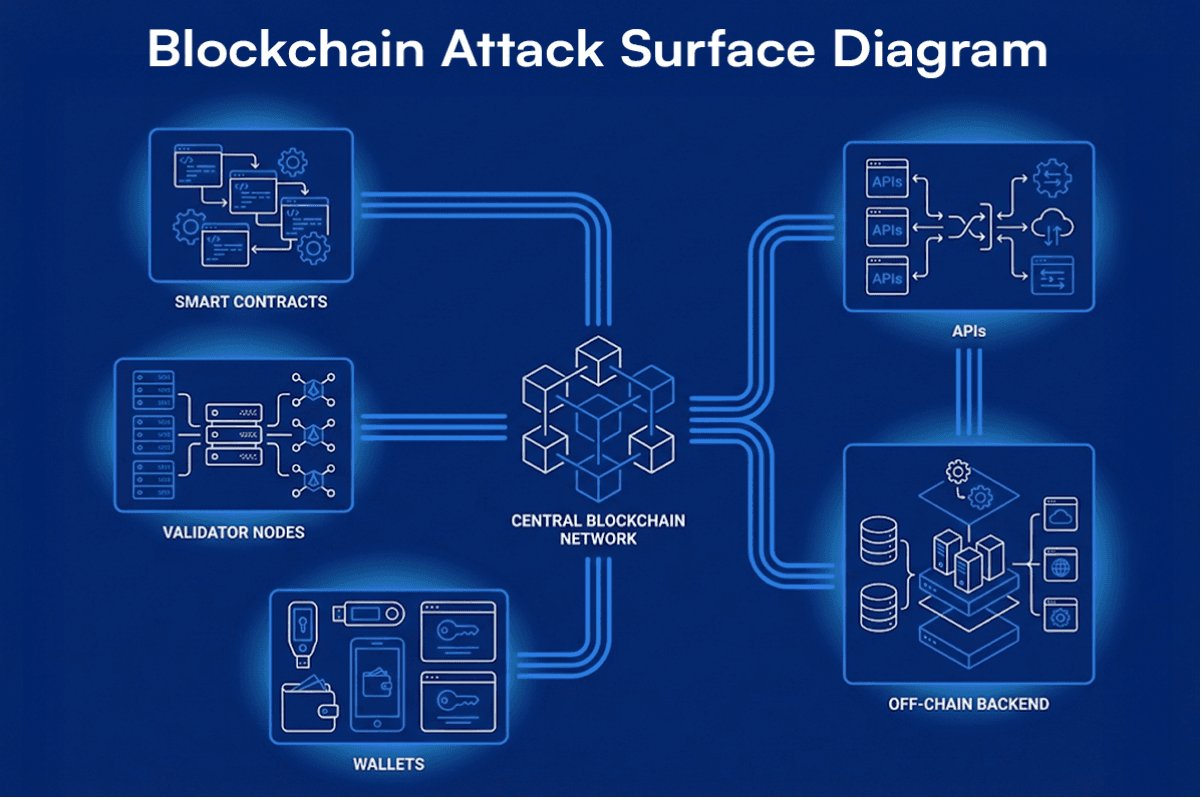
What Blockchain Penetration Testing Really Means
Blockchain penetration testing is the structured process of identifying real world security weaknesses across a blockchain ecosystem.
It goes beyond smart contracts alone. A proper engagement evaluates how contracts, nodes, wallets, APIs, off chain components, and governance mechanisms behave under attack conditions.
The goal is simple. Find exploitable weaknesses before someone else does, and provide clear guidance on how to fix them.
For companies working with a PTaaS provider like Capture The Bug, this testing is delivered continuously, with visibility into findings as they are validated.
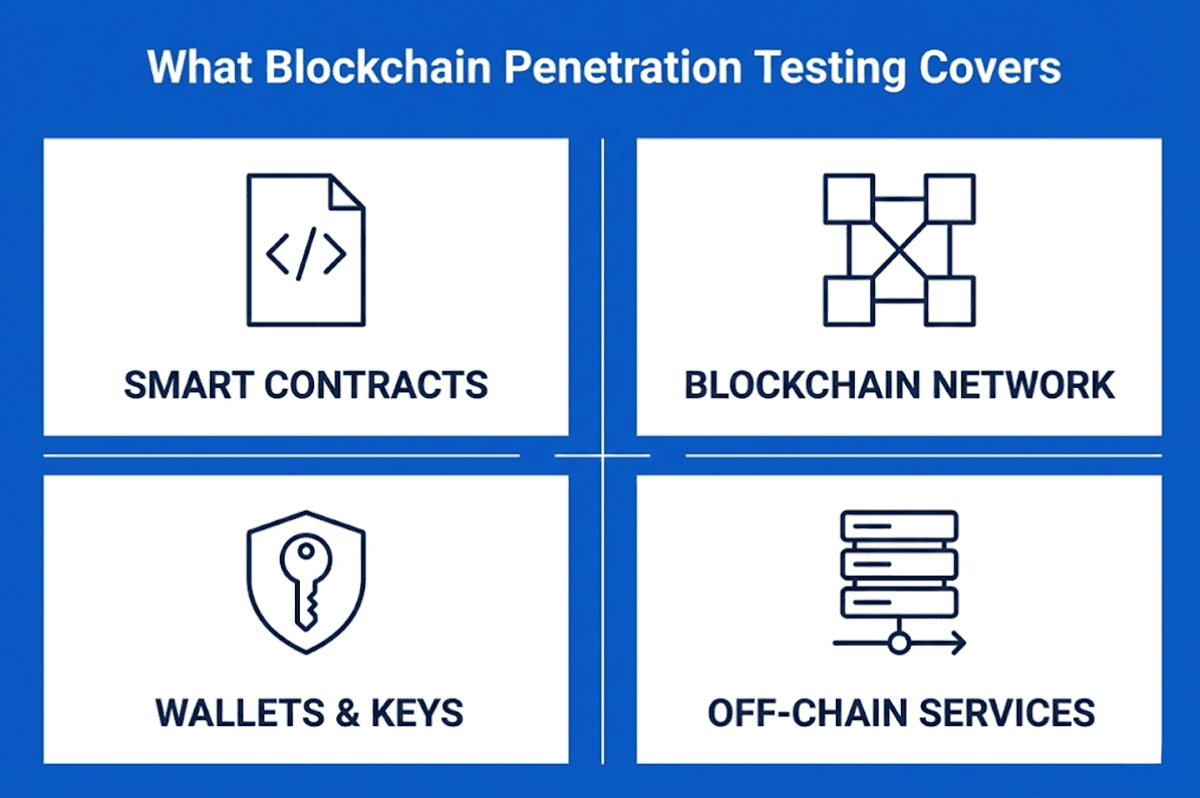
Why Blockchain Systems Still Get Breached
There is a common misconception that blockchain technology is secure by default. In reality, most successful attacks happen because of design and implementation issues, not because cryptography failed.
The most common root causes include:
- Business logic errors inside smart contracts
- Weak access controls on admin functions
- Unsafe interactions between contracts
- Misconfigured nodes and exposed RPC endpoints
- Poor key and wallet management
- Unsecured off chain services that interact with the chain
Blockchain penetration testing focuses on these real attack paths, not theoretical risks.
Step 1: Scoping and Architecture Discovery
Every effective blockchain penetration test starts with understanding how the system is actually built.
This phase answers questions such as:
- Which blockchain networks are used
- How smart contracts interact with each other
- Where off chain services connect to the chain
- How wallets, keys, and signing processes are handled
- Which components are internet exposed
Discovery is not paperwork. It is a technical deep dive into architecture, deployment models, and trust boundaries.
Without this clarity, testing becomes shallow and misses critical attack paths.
Step 2: Smart Contract Security Assessment
Smart contracts are often the highest value target because a single flaw can lead to irreversible loss of assets.
A blockchain penetration test evaluates contracts for issues such as:
Reentrancy flaws
Where external calls allow attackers to repeatedly drain funds before balances are updated.
Arithmetic errors
Overflows or underflows that cause incorrect calculations and asset manipulation.
Access control weaknesses
Admin or privileged functions that can be abused due to missing or incorrect permission checks.
Logic and state errors
Conditions where contracts behave correctly in isolation but fail when interacting with others.
Testing here focuses on exploitability. The question is not whether a pattern exists, but whether it can be used to steal value or break guarantees.
Step 3: Blockchain Network and Node Testing
Even the best smart contracts can be compromised if the surrounding infrastructure is weak.
This phase examines how nodes and network services are deployed and protected.
Key areas include:
- Publicly exposed node interfaces
- Weak authentication on RPC services
- Denial of service conditions that disrupt consensus participation
- Replay or message manipulation risks in transaction handling
Attackers often target these layers because they are easier to exploit than hardened contracts.
Step 4: Wallet, Key, and Signing Workflow Review
Private keys are the keys to the kingdom. Many blockchain incidents are not protocol failures but key management failures.
Penetration testing evaluates:
- How keys are generated and stored
- Whether signing workflows can be abused
- Exposure risks in hot wallet setups
- Separation of duties for high value transactions
A secure blockchain application assumes that keys will be targeted. Testing validates whether that assumption holds.
Step 5: Off Chain and API Security Testing
Most production blockchain systems rely heavily on off chain components.
These include:
- Backend services that trigger transactions
- APIs that expose blockchain data
- Admin panels for contract management
- Oracles and third party integrations
If an attacker compromises these systems, they may never need to attack the chain directly.
Blockchain penetration testing therefore treats off chain services as first class attack surfaces, not secondary concerns.
Step 6: Exploitation and Impact Validation
Finding weaknesses is not enough. A professional penetration test proves impact.
This means demonstrating:
- Whether assets can be stolen or frozen
- Whether governance controls can be bypassed
- Whether transaction integrity can be manipulated
- Whether denial of service is realistic
This step separates theoretical issues from real business risk.
For decision makers, this is where security becomes measurable.
Step 7: Reporting That Engineers Can Use
A blockchain penetration test is only as valuable as its report.
Effective reporting includes:
- Clear explanation of each issue
- Reproduction steps without ambiguity
- Real world impact description
- Practical remediation guidance
There is no value in vague warnings or generic advice. Reports should help teams fix problems, not decode them.
Step 8: Remediation and Retesting
Security is not complete when a report is delivered.
Fixes need to be validated, especially in blockchain environments where mistakes can be irreversible once deployed.
Modern PTaaS models allow teams to request retesting as soon as fixes are applied, reducing exposure windows and preventing regressions.
Common Mistakes in Blockchain Penetration Testing
Organizations often fall into these traps:
- Testing only smart contracts and ignoring infrastructure
- Treating blockchain security as a one time event
- Relying on generic checklists instead of tailored testing
- Accepting reports that list issues without proof of impact
Avoiding these mistakes is what separates compliance driven testing from real security.
When Blockchain Penetration Testing Should Happen
Testing should not be delayed until after launch.
The most effective approach includes:
- Testing before mainnet deployment
- Testing after major contract upgrades
- Ongoing testing as integrations evolve
- Retesting after remediation
Blockchain systems change continuously. Security validation should do the same.

Final Thoughts
Blockchain technology changes how trust is built, but it does not remove the need for security testing. In many ways, it raises the stakes.
Blockchain penetration testing provides clarity in an environment where mistakes are costly and often irreversible. When done correctly, it protects users, preserves trust, and supports long term growth.
For organizations building serious blockchain products, this process is not a nice to have. It is part of responsible engineering.
FAQ
What is blockchain penetration testing?
It is the process of identifying and validating exploitable security weaknesses across smart contracts, blockchain networks, wallets, and off chain components.
Is smart contract auditing enough?
No. Smart contract reviews are important, but they do not cover infrastructure, APIs, wallets, or operational risks.
How often should blockchain penetration testing be done?
Before launch, after major changes, and continuously for production systems.
Can blockchain vulnerabilities be fixed after deployment?
Sometimes, but not always. This is why testing before deployment is critical.
Who should perform blockchain penetration testing?
Experienced security teams with deep understanding of blockchain systems and real world attack methods.